






The High-Altitude Advantage
Photographing the cosmos from a Himalayan peak is like getting a front-row seat. At altitudes of 12,000 feet or more, there is simply less atmosphere between your camera and the stars. This thin air significantly reduces atmospheric distortion, the turbulence
and haze that can blur celestial details and make stars twinkle. Less air means less scattering of light, leading to sharper, more brilliant stars and a clearer view of faint structures within the Milky Way's galactic core. It’s a fundamental advantage that sea-level locations, no matter how dark, cannot replicate.
Unrivaled Darkness and Clarity
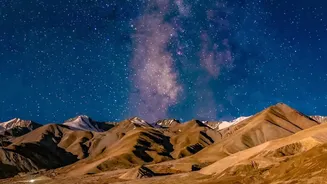
Light pollution is the number one enemy of astrophotography, washing out the night sky and hiding all but the brightest stars. Vast regions in the Himalayas, such as Hanle in Ladakh—home to India’s first official Dark Sky Reserve—are among the least light-polluted places on Earth. These areas are rated as Bortle Class 1 or 2, the darkest skies measurable, where the Milky Way can be so bright it is visible to the naked eye with stunning texture and detail. This level of darkness, combined with the region’s remoteness from major urban centers, ensures a pure, ink-black canvas.
Exceptionally Crisp, Dry Air
Humidity is a hidden villain for night photographers. Water vapor in the atmosphere absorbs and scatters starlight, reducing contrast and clarity. The high-altitude deserts of Ladakh and Spiti Valley are located in a rain shadow, meaning they are shielded from the heavy moisture of the monsoons that affect much of the subcontinent. This results in an exceptionally dry climate with extremely low humidity, a key factor noted by astronomers for pristine viewing conditions. This 'bone-dry' air allows light from distant nebulae and galaxies to travel to your lens with minimal interference, producing images that are crisp and vibrant.
A Unique Seasonal Window
The geography of the Himalayas provides a strategic advantage for photographers. While much of India experiences cloudy skies during the summer monsoon season (June to September), the trans-Himalayan regions of Ladakh and Spiti remain largely clear. This period happens to coincide with the peak visibility of the Milky Way's galactic core in the Northern Hemisphere. This alignment creates a perfect seasonal window, allowing photographers to capture the brightest part of our galaxy during months when it might be impossible elsewhere on the continent.
Dramatic Foreground Landscapes
Great astrophotography isn't just about the sky; it's about the composition. A compelling foreground gives scale and context to the cosmos. The Himalayas offer some of the most dramatic landscapes on the planet, from snowcapped 6,000m peaks and ancient monasteries to serene high altitude lakes. Incorporating these epic terrestrial elements into a shot of the Milky Way creates a powerful sense of place and wonder that a simple sky photo cannot match. Villages like Langza, with its iconic Buddha statue, or lakes like Pangong Tso provide world class foregrounds that anchor the celestial display.