





The Great Monsoon Misconception
It’s a common habit across India: as soon as the monsoon arrives, the sunscreen bottle gets pushed to the back of the shelf. The logic seems simple – no sun, no damage. Unfortunately, this is one of the most persistent myths in skincare. While clouds
and rain make the weather cooler and block visible sunlight, they don't stop the invisible ultraviolet (UV) radiation that harms your skin. Dermatologists warn that skipping sun protection during the monsoon is a mistake that can lead to long-term skin issues like pigmentation, premature ageing, and an increased risk of skin cancer.
Understanding the Invisible Threat: UVA vs. UVB
The sun emits two main types of UV rays that reach us on Earth: UVA and UVB. Think of them as two different kinds of trouble. UVB rays are shorter, higher-energy rays that are responsible for immediate damage like sunburn. Their intensity fluctuates more with direct sunlight. UVA rays, on the other hand, have a longer wavelength and make up about 95% of the UV radiation reaching us. They penetrate deeper into the skin, breaking down collagen and leading to wrinkles, fine lines, and long-term ageing. Crucially, UVA rays are present all day long, throughout the year, and they are not significantly blocked by clouds or even window glass.
How Clouds Deceive Us
Clouds are excellent at blocking visible light, which is why it feels darker on an overcast day. However, they are far less effective at filtering out UV radiation. Studies show that up to 80% of UV rays can penetrate through cloud cover. In some cases, a phenomenon known as the 'broken-cloud effect' can even scatter and reflect UV rays, increasing your total exposure to levels higher than on a perfectly clear day. Furthermore, wet surfaces during the monsoon—like puddles, roads, and buildings—can reflect UV rays, amplifying your exposure from different angles.
Choosing Your Monsoon Shield: The Right Sunscreen
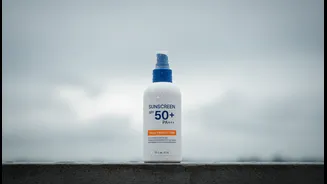
For the humid Indian monsoon, your choice of sunscreen is key. A heavy, greasy formula is likely to be skipped. Dermatologists recommend looking for a few key features. First, choose a 'broad-spectrum' sunscreen, which means it protects against both UVA and UVB rays. Look for an SPF of 30 or, ideally, 50. The 'PA' rating (often seen as PA+, PA++, etc.) specifically indicates the level of UVA protection; a rating of PA+++ or PA++++ is excellent for Indian conditions. Given the humidity and rain, a water-resistant formula is also a wise choice. For those with oily or acne-prone skin, lightweight gel or silicone-based formulations provide a matte finish without clogging pores.
Application Is Everything
Even the best sunscreen is only effective if applied correctly. A common mistake is not using enough. For your face and neck, you should aim for about a 'two-finger' length of product. Apply it as the last step of your morning skincare routine, about 15-20 minutes before you head out. Reapplication is just as important, especially in a humid climate where sweating is common. The general rule is to reapply every two hours if you are outdoors, or after heavy sweating or getting wet. Making sunscreen a non-negotiable daily habit, like brushing your teeth, is the most effective way to protect your skin year-round.