




A World of Contradictions
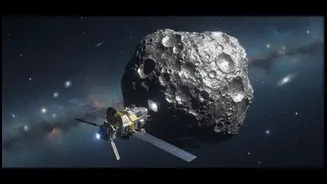
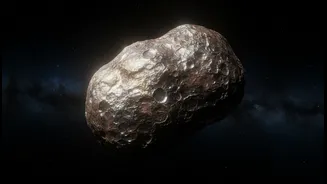
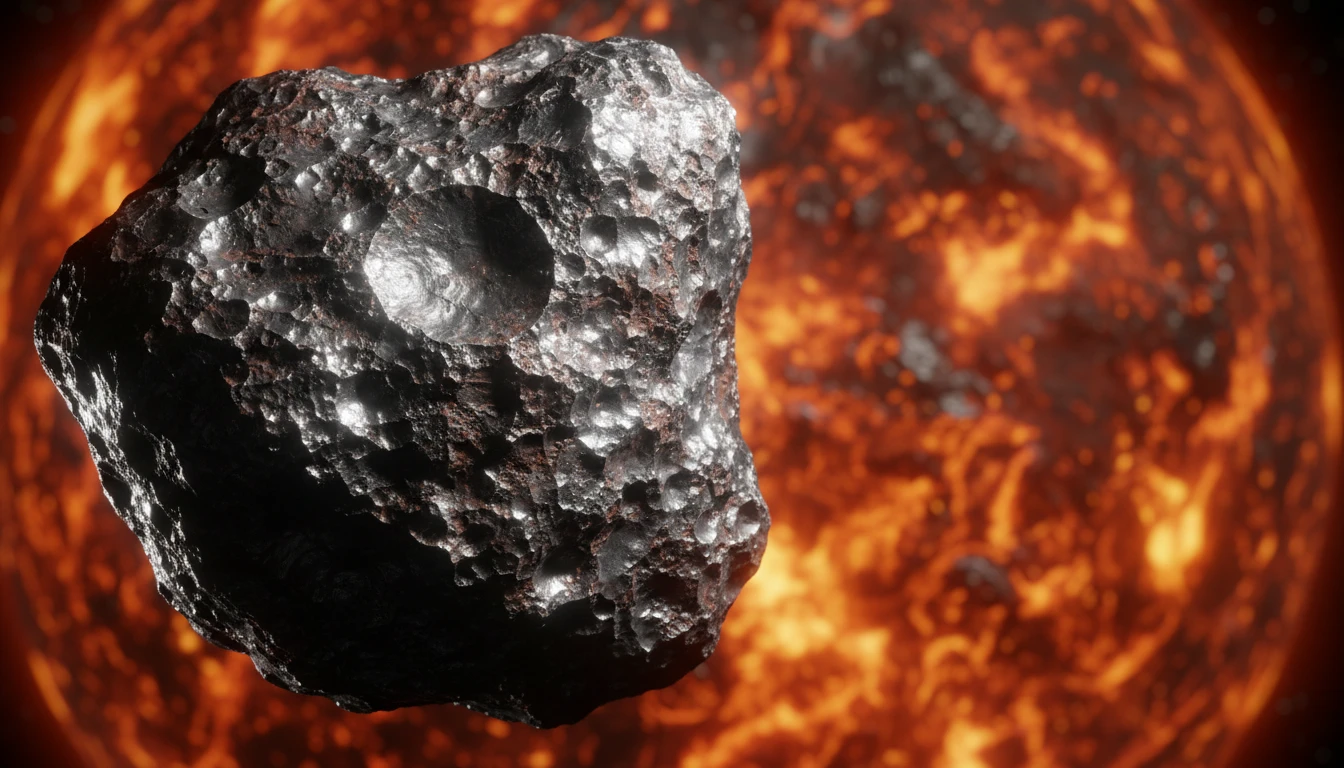
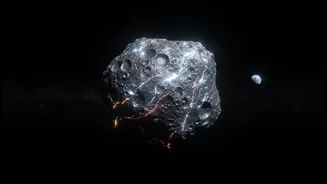
Located in the main asteroid belt between Mars and Jupiter, 16 Psyche is no ordinary space rock. It is the largest known metallic M-type asteroid, measuring over 200 kilometers in diameter. For years, astronomers have theorized it could be the exposed
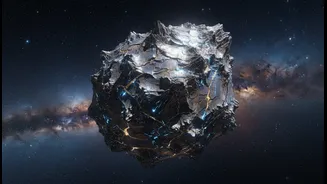
iron-nickel core of a protoplanet—a tiny, would-be planet whose rocky outer layers were violently stripped away in ancient collisions. Studying it would be like getting a direct look at the core of a planet like Earth, a place we can never reach. But there's a problem with this theory. Observations of Psyche's gravitational pull on its neighbors suggest its density is surprisingly low—far less than a solid chunk of iron. If it is all metal, it would need to be incredibly porous, with almost half its volume being empty space, like a giant ball of steel wool. This contradiction has fueled a long-standing debate: is Psyche a highly porous metal body or a jumbled mixture of rock and metal?
Clues from Virtual Craters
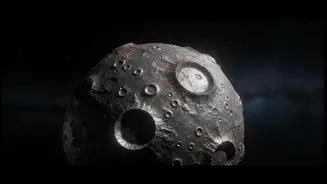
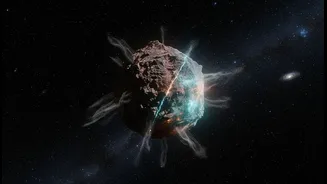
Since we can't just slice Psyche open, scientists are getting creative. The latest insights, published in early 2026, come not from a telescope but from powerful computer simulations. A team of researchers at the University of Arizona decided to investigate Psyche's structure by recreating the formation of its massive craters. Using detailed 3D models of the asteroid's potato-like shape, they simulated giant impacts to see what kind of scars they would leave behind based on different internal compositions. They tested two primary scenarios for Psyche's origin. The first is a layered body, with a metallic core and a thin, rocky mantle, consistent with the 'stripped protoplanet' theory. The second is a more chaotic, uniform mixture of metal and silicate rock, which could have resulted from a catastrophic impact that jumbled all its materials together.
The Critical Role of Porosity
The simulations revealed that the amount of empty space inside the asteroid—its porosity—plays a huge role in how craters form. This factor is often ignored in models because it's complex, but the research shows it can dramatically affect the outcome of an impact. When an asteroid is highly porous, it acts like a sponge, absorbing much of the impact energy. This results in deeper, steeper craters with less material thrown across the surface. By contrast, a solid, less porous body would produce shallower craters and a wider debris field. This key finding gives scientists a testable prediction. When a spacecraft finally gets a close-up look at Psyche's craters, their shape and depth will provide crucial clues about the structure hidden beneath.
Awaiting the Final Verdict
Interestingly, the simulations showed that the known dimensions of a large crater near Psyche's north pole could be created in both the layered-core and mixed-jumble scenarios. This means we still can't definitively say which origin story is correct. However, we now have a clear roadmap for what to look for. The ultimate arbiter in this cosmic mystery will be NASA's Psyche mission. The spacecraft launched successfully in October 2023 and, as of May 2026, completed a crucial gravity-assist flyby of Mars that put it on a direct course for the asteroid. It is scheduled to arrive at 16 Psyche in August 2029. Once there, it will spend nearly two years in orbit, using a suite of instruments to map the surface, measure the gravity field, and determine the asteroid's precise composition.