



Seeing the Invisible with Infrared
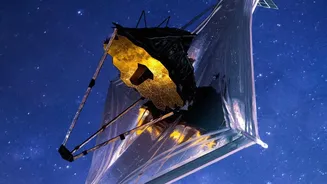
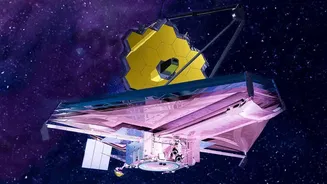
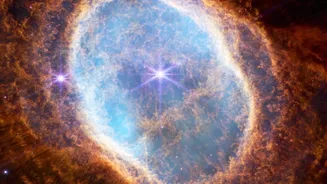
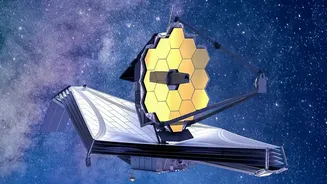
The magic behind the James Webb Space Telescope (JWST) lies in its ability to see the universe in infrared light. Unlike visible light, which our eyes can see, infrared is a range of light that is often felt as heat. Many of the most interesting cosmic
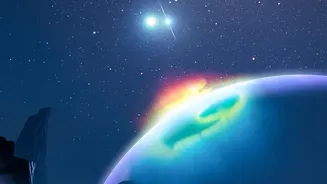
objects, from the earliest galaxies to newly forming planets, are too cool or too distant to shine brightly in visible light. Their faint glow is primarily in the infrared spectrum. This is especially true for the atmospheres of exoplanets—planets outside our solar system. The chemical elements and molecules within a planet's atmosphere absorb very specific wavelengths of light. By looking in the infrared, JWST can pick up chemical fingerprints that are completely invisible to other telescopes, including the tell-tale signs of water.
The Telescope's Twin Super-Senses
To perform this cosmic detective work, JWST relies on a suite of four powerful scientific instruments. For hunting water, two are particularly crucial: the Near-Infrared Spectrograph (NIRSpec) and the Mid-Infrared Instrument (MIRI). Think of them as the telescope's super-senses, each tuned to a specific part of the infrared spectrum. NIRSpec covers the near-infrared range (0.6 to 5.3 micrometres), while MIRI handles the mid-infrared (5 to 28 micrometres). Working together, they provide an incredibly broad and detailed view. NIRSpec can observe 100 objects simultaneously, making it highly efficient, while MIRI, which is cooled to a frigid 7 Kelvin (minus 266 degrees Celsius), can detect the faint heat signatures from cooler, more distant objects.
Decoding a Planet's Atmosphere
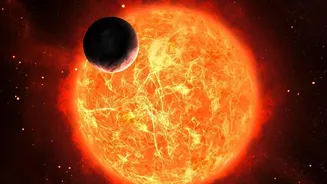
The primary method JWST uses is called transmission spectroscopy. When an exoplanet passes in front of its host star from our point of view (an event called a 'transit'), a tiny fraction of the starlight filters through the planet's atmosphere. Molecules in the atmosphere, like water (H2O), carbon dioxide, or methane, absorb very specific colours, or wavelengths, of that starlight. The spectrographs on JWST, like NIRSpec and MIRI, act like high-tech prisms, splitting the starlight into a rainbow, or spectrum. By looking at which colours are missing from this spectrum, astronomers can definitively identify the molecules present. A specific pattern of missing light is like a barcode for water, providing a clear and distinct signature.
From Theory to Reality: Water Confirmed
This isn't just theory; it's delivering breathtaking results. JWST has already provided the most detailed analysis to date of an exoplanet's atmosphere for worlds like WASP-96 b, a hot gas giant where the signature of water was clearly detected. For another planet, WASP-39 b, observations provided a full menu of atmospheric molecules, including water, carbon dioxide, and even sulfur dioxide, hinting at active chemistry. More recently, in July 2026, astronomers announced the detection of 'semi-heavy water' in WASP-39 b's atmosphere, a specific isotope of water that can provide clues about how the planet formed and migrated over billions of years. These discoveries prove that the telescope's instruments are performing even better than expected, capable of teasing out subtle molecular details from hundreds of light-years away.
Why This Changes Everything
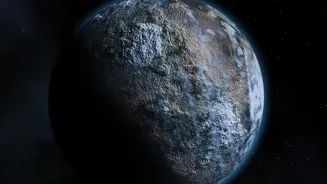
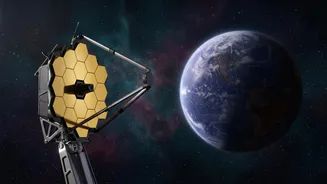
Finding water is a critical step in the search for life beyond Earth. While gas giants like WASP-96 b are not habitable, proving that JWST can reliably find water there is a monumental proof of concept. It paves the way for studying smaller, rocky, and potentially habitable worlds. NASA has already used JWST to probe the atmosphere of K2-18 b, a potential 'Hycean' world with a hydrogen-rich atmosphere and a possible water ocean, finding strong signs of water vapour. The precision of NIRSpec and MIRI allows scientists to not just find water, but to begin quantifying it and understanding its context alongside other molecules. This capability moves the field of exoplanet science from simply detecting planets to truly characterizing their environments, a crucial step in identifying worlds that might have the right conditions for life to arise.