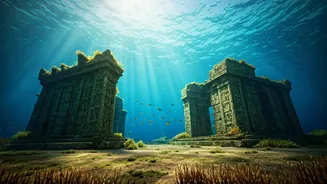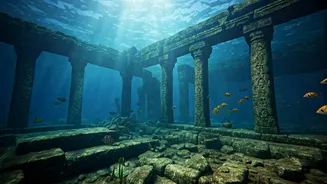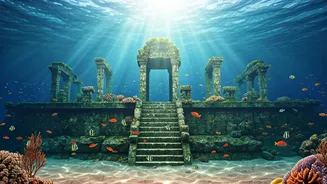







The Legend of the Seven Pagodas
The magnificent Shore Temple in Mahabalipuram, a UNESCO World Heritage site, has stood against the Bay of Bengal for over 1,300 years. But for just as long, local folklore and the accounts of early European travellers have spoken of not one, but seven
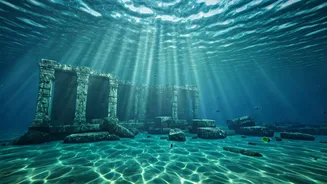
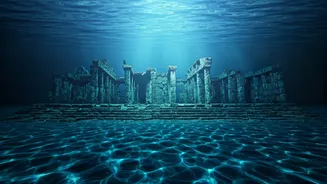
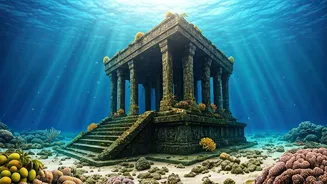
temples, with six others lost to the sea. This tale of the ‘Seven Pagodas’ describes a city so beautiful that the gods grew envious and sent a great flood to submerge it, leaving only the Shore Temple as a silent witness. For generations, fishermen have claimed to glimpse the glittering tops of these sunken structures beneath the waves on clear days, a story long dismissed by many as mere myth.
Science Dives into the Myth
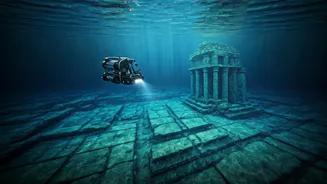
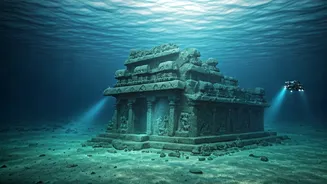
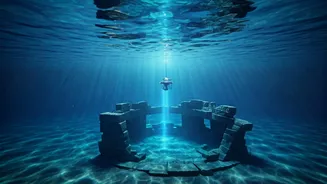
The story began to shift from legend to fact in the early 2000s, and most dramatically after the 2004 tsunami. As the sea receded hundreds of metres, onlookers reported seeing long rows of large stone blocks and other structures before the waves returned. This event galvanised scientific interest, prompting explorations by institutions like the National Institute of Oceanography (NIO) and the Archaeological Survey of India (ASI). Initial dives and surveys found scattered, man-made structures. Now, newer explorations are deploying advanced sonar technology and Remotely Operated Vehicles (ROVs) to systematically map these underwater sites with unprecedented clarity, penetrating depths and layers of sediment without disturbing the fragile remains.
What the Sonar Has Revealed
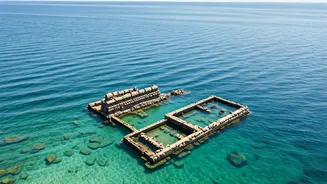
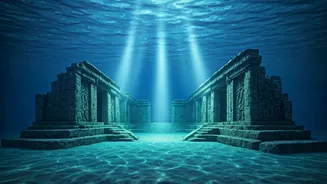
The sonar surveys have mapped extensive man-made features scattered over a large area, from 500 to 800 metres from the coast and at depths of up to 9 metres. These are not random stones, but the clear outlines of walls, some several metres long, along with staircases, platforms, and dressed stone blocks with chisel marks and joinery projections, suggesting they were part of a larger complex. While thick marine growth covers many surfaces, the layout of these structures indicates they were part of a planned settlement, likely a temple complex or even a port city that existed before the Pallava dynasty.
Piecing Together a Submerged Past
Archaeologists believe these finds confirm that Mahabalipuram was a much larger and older settlement than previously thought. Radiocarbon dating of materials found on the submerged structures places some of them as far back as the first century, long before the Pallava kings built the Shore Temple. This suggests a pre-Pallava port was active here. The underwater structures show similarities in construction to the Shore Temple, using interlocking blocks of stone without mortar, but their age points to an even earlier period of habitation that was gradually claimed by the sea. Scientists theorise that a combination of rising sea levels, coastal erosion, and possibly catastrophic events like tsunamis or earthquakes led to the submergence over centuries.
More Than Just Stones and Walls
These discoveries are rewriting the history of this part of the Indian coast. They validate centuries of oral tradition and demonstrate the deep historical roots of the Tamil civilisation. The Tamil Nadu government has been actively supporting further archaeological work, both on land in sites like Keeladi and offshore at ancient ports, to scientifically establish the antiquity and reach of ancient Tamil society. The Mahabalipuram findings are a key part of this larger effort to understand India’s maritime past. They show how ancient communities lived with, and were sometimes overcome by, the power of the ocean.