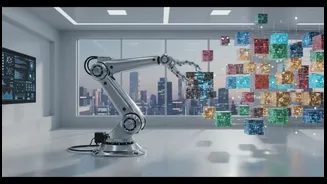









The Allure of the Black Box
It’s easy to see the appeal. Generative AI tools can draft an email, design a logo, or debug code in seconds. They offer a seductive shortcut past the often messy, time-consuming, and frustrating parts of creative and analytical work. For businesses,
this translates to speed and perceived efficiency, while for individuals, it can be a welcome cure for writer's block or a looming deadline. The temptation is to take the polished output and present it as our own, with the complex digital machinery that created it remaining a complete mystery. This “black box” approach, where the process is invisible and only the result matters, seems like the ultimate productivity hack. But this convenience comes at a steep, often hidden, cost.
What We Lose in the Middle
The real work—the true source of learning and mastery—happens in the process, not the product. It’s in the failed experiments, the awkward first drafts, the deleted lines of code, and the clashing colour palettes that we build intuition and develop critical judgment. When we outsource the entire journey to an algorithm, we rob ourselves of these crucial growth opportunities. A recent global study found that half of senior executives are already observing 'de-skilling' in their organizations due to AI. Skills like critical thinking, problem framing, and creative judgment are the most at risk when employees over-rely on AI to provide answers instead of assists. This isn't just an individual problem; it's an organizational one that threatens to create a workforce that is highly efficient at executing but poor at innovating.
A Better Way: AI as a Practice Partner
The alternative isn't to reject AI, but to reframe its role. Instead of a magic box that delivers a finished product, we should demand and champion tools that act as a collaborator. Imagine an AI that doesn't just give you one answer, but instead generates multiple variations to help you compare and refine your thinking. Picture a coding assistant that doesn’t just fix a bug, but explains why the bug occurred, turning a frustrating error into a teachable moment. These tools exist, but they require a philosophical shift. We must move from valuing the speed of the output to valuing the depth of the process. This approach treats AI not as a replacement for creativity, but as a tool that expands it. It becomes a sparring partner for ideas, a tireless research assistant, and a guide that helps us navigate complex problems without solving them for us.
Transparency Builds Trust and Skill
In professional settings, hiding AI's involvement is becoming a risky gamble. As one report noted, when AI use isn't clear, it shifts from a workflow choice to a client risk. Ethical practice requires clear labeling and disclosure of AI-assisted content to maintain trust with clients and audiences. But beyond ethics, being transparent about the process offers a new form of digital craftsmanship. Showing how AI was used to brainstorm, iterate, or refine an idea demonstrates confidence and control. It proves that the human creator was in the driver's seat, using the tool with intention rather than leaning on it as a crutch. This transparency is essential for learning environments, where educators are exploring how to use AI to support study habits and research skills rather than just complete assignments.
Avoiding the Homogenization of Ideas
One of the greatest long-term dangers of black box AI is the homogenization of creativity and thought. If everyone is drawing from the same well of algorithmically generated ideas, our work—be it marketing copy, visual design, or even strategic analysis—risks becoming dangerously uniform. AI models are trained on existing data, and without critical human intervention, they can perpetuate biases and simply regurgitate stylized versions of what's already popular. Expanding our practice means using AI to explore the fringes and challenge conventions, not just to find the statistical average of a 'good' idea. By keeping the process visible and interactive, we ensure that human intuition, cultural context, and personal experience remain the driving forces behind our work, with AI serving as a powerful amplifier, not a homogenizing filter.