



The Universe's Three Black Hole Sizes
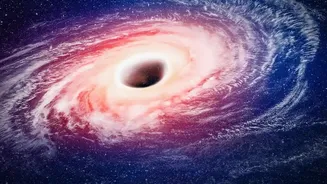
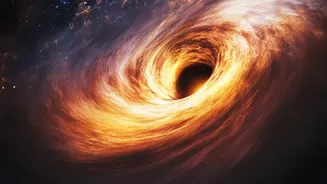
Think of black holes, and you might imagine two kinds. First are the stellar-mass black holes, typically 5 to a few dozen times the mass of our Sun, formed from the explosive deaths of massive stars. On the other extreme are the supermassive black holes, behemoths
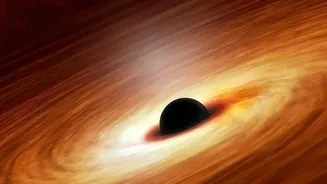
millions or billions of times our Sun’s mass, found lurking at the heart of most large galaxies, including our own Milky Way. But what about the ones in between? Scientists have long theorised the existence of intermediate-mass black holes (IMBHs), ranging from a hundred to hundreds of thousands of solar masses. These have been incredibly difficult to find, earning them the nickname of the cosmic 'missing link'. Finding them is crucial because they could be the key to understanding how supermassive black holes get so supermassive in the first place.
A 'Chirp' from the Dawn of Time
Detecting black holes, which swallow light, is not easy. Scientists can't see them directly. Instead, they listen for them. When two black holes spiral into each other and merge, they unleash a torrent of energy in the form of gravitational waves—ripples in the very fabric of spacetime. Observatories like LIGO in the United States, Virgo in Italy, and KAGRA in Japan are designed to detect these faint tremors. As the black holes get closer, the frequency of these waves increases rapidly, creating a characteristic 'chirp' that the detectors can pick up. By analysing the properties of this signal, scientists can deduce the masses and even the spins of the merging objects. It’s through these cosmic echoes that the latest discovery was made possible.
A Landmark Observation
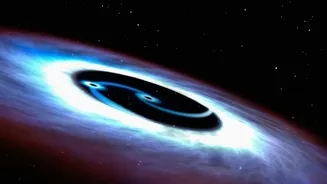
Recent analyses of gravitational wave data have provided the strongest evidence yet for the merger of IMBHs. One of the first landmark events, GW190521, involved two black holes of about 85 and 66 solar masses, which combined to form a new black hole of about 150 solar masses—the first confirmed IMBH created by a merger. More recent observations have continued to build this picture. Scientists are finding evidence that some mergers involve 'second-generation' black holes—objects that were themselves formed from previous collisions. These events are often characterised by high-speed spins, which is a tell-tale sign that a black hole wasn't born from a single star but from a previous violent merger.
Solving the Supermassive Puzzle
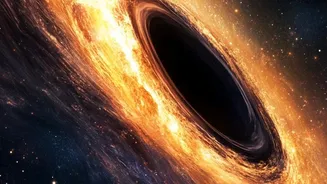
The detection of these mergers is a breakthrough because it validates a leading theory called 'hierarchical merging'. This theory proposes that supermassive black holes didn't just appear fully formed; they grew over billions of years. The process likely started with smaller, stellar-mass black holes. In dense environments like globular clusters or the centers of young galaxies, these black holes would have repeatedly merged, getting bigger each time. These collisions would create IMBHs, which would then continue to merge with other black holes or swallow stars and gas, eventually growing into the giants we see today. By observing IMBHs in the act of merging, we are seeing this cosmic construction process in action for the first time, filling in a huge gap in the story of galaxy evolution.
A New Era of Cosmic Archaeology
This discovery does more than just solve one puzzle; it opens up a whole new field of cosmic archaeology. Each merger gives us a snapshot of the universe at a different point in its history. Some of these events are so distant that their gravitational waves have been travelling for billions of years to reach us. The data gathered by LIGO, Virgo, and KAGRA are helping scientists create a census of black holes across the universe, revealing different populations and formation pathways. Furthermore, the confirmation of wandering black holes, sometimes found far from galactic centres, supports the idea that galaxy mergers play a huge role in scattering and growing these cosmic objects. Future observatories, including the space-based LISA, promise to detect even more of these events, offering a clearer picture of the universe's chaotic and creative adolescence.