






The Old Worry: A TCS Recap
For years, Indian travellers faced a significant upfront cost when planning international trips: Tax Collected at Source (TCS). This tax was collected by travel agents or banks on payments for overseas tour packages and other foreign remittances under
the Liberalised Remittance Scheme (LRS). Before the latest budget, travellers faced rates as high as 20% on tour packages costing more than ₹10 lakh, and 5% on amounts above ₹10 lakh for expenses like self-funded education or medical treatment. While TCS is not an extra tax and it can be claimed back or adjusted against your total income tax liability, it created a major liquidity issue. A large chunk of travel money was blocked at the time of booking, sometimes for months, until tax returns were filed.
What Changed in Budget 2026?
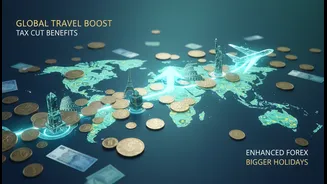
The Union Budget 2026 provided a major overhaul, simplifying and slashing these rates. For overseas tour packages, the previous 5% and 20% slabs were replaced with a single, flat 2% TCS rate, with no minimum amount threshold. Similarly, for self-funded education and medical expenses remitted abroad, the TCS rate on amounts exceeding ₹10 lakh was reduced from 5% to 2%. This change, effective from April 1, 2026, was designed to ease the immediate cash pressure on travellers and families, improving short-term liquidity without changing the final tax liability. However, for other remittances like overseas investments or gifts, the 20% TCS on amounts over ₹10 lakh remains unchanged.
The New Challenge: Unmasking Hidden Fees
With the headache of high TCS largely gone for travellers, the financial focus is shifting to less-obvious charges that can quietly inflate your travel budget. While you might save thousands on upfront tax, you could still be losing a significant amount to forex markups and currency conversion fees that are often buried in the fine print of your card statements. These charges are not taxes and are not refundable; they are fees charged by banks and payment processors for the service of converting your rupees into a foreign currency. A recent report highlighted that while 78% of Indians plan to increase travel spending after the TCS cut, many remain unaware of the true cost of foreign exchange.
Enemy #1: The Forex Markup Fee
Almost every time you use a standard Indian debit or credit card for an international transaction, you are hit with a foreign exchange (forex) markup fee. This fee, typically ranging from 2.5% to 3.5%, is charged by your bank on top of the currency conversion rate set by networks like Visa or Mastercard. It might seem small, but on total trip spending of ₹2,00,000, a 3.5% markup translates to a ₹7,000 loss. Many travellers only discover these costs after reviewing their statements upon return. The best way to combat this is by using a forex card, which is a prepaid travel card, or specific credit cards that offer a low or zero forex markup.
Enemy #2: Dynamic Currency Conversion (DCC)
Another costly trap is Dynamic Currency Conversion (DCC). This happens when a merchant's card machine abroad offers you the 'convenience' of paying in Indian Rupees (INR) instead of the local currency. While it seems helpful to see the cost in a familiar currency, accepting this offer is almost always a mistake. The exchange rate used for DCC includes a hefty markup, often 5-8% higher than standard rates. The rule for any savvy traveller is simple: always choose to pay in the local currency of the country you are in. Your own bank's conversion rate, even with its markup, is usually far better than the one offered through DCC.
Your Financial Game Plan for Travel
Now that TCS is less of a concern for tour packages, optimising your spending strategy is key. First, consider a prepaid forex card or a zero-markup credit card for your primary spending to minimise conversion costs. Second, when using any card, always decline the option to pay in INR and insist on paying in the local currency to avoid DCC charges. For cash, avoid exchanging large amounts at airport counters, which offer poor rates, and instead use ATMs from banks that have alliances with your Indian bank to reduce withdrawal fees. Finally, while the TCS on tour packages is a flat 2%, remember that booking flights and hotels separately means the transaction may not be classified as a 'tour package', which could alter how TCS applies.