
Our Digital Locks Are Breakable
Think of today's digital security like a very complex lock. The keys are created using math problems so hard that current computers would take thousands of years to pick them. We use this method for everything, from bank transfers to confidential government
messages. The problem? A new kind of computer—a quantum computer—is on the horizon. For these machines, our super-hard math problems would be trivial, turning our most secure locks into flimsy padlocks. This is known as the 'Harvest Now, Decrypt Later' threat, where adversaries are already stealing encrypted data, confident they'll be able to unlock it in the future.
The Unhackable Postcard
Quantum communication offers a fundamentally different kind of security. Its most common application is Quantum Key Distribution (QKD), which creates an encryption key that is physically impossible to intercept without being detected. Imagine sending a secret key on a postcard made of soap bubbles. If anyone tries to grab it, the bubble pops, and both you and the intended recipient instantly know the key has been compromised. In the quantum world, this is thanks to the principles of quantum mechanics. Information is encoded onto single particles of light, or photons. The very act of a third party observing a photon changes its state, leaving behind undeniable evidence of eavesdropping. If there's any sign of interference, the parties discard the key and generate a new one. It’s security guaranteed by the laws of physics, not just by complex math.
ISRO's Breakthrough Moment
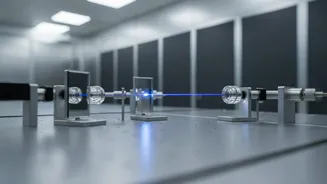
This isn't just theory. The Indian Space Research Organisation (ISRO) has been making significant, real-world progress. In a landmark achievement, ISRO successfully demonstrated free-space QKD between two buildings 300 meters apart. During this test, scientists were able to conduct a live videoconference using signals encrypted with a quantum key. The demonstration showcased a suite of indigenously developed technologies, including a method for synchronizing the transmitter and receiver using India's own NavIC satellite navigation system. These successful ground-based tests are a crucial stepping stone for ISRO's ultimate goal: implementing Satellite-Based Quantum Communication (SBQC). The agency is now preparing for demonstrations between two Indian ground stations, paving the way for a satellite-based system.
From Ground Level to Global Reach
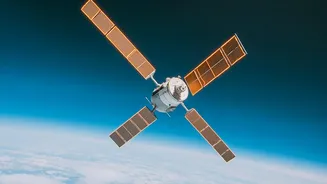
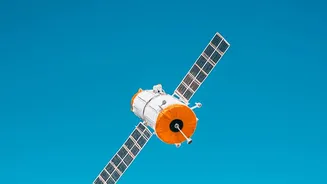
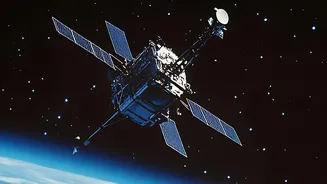
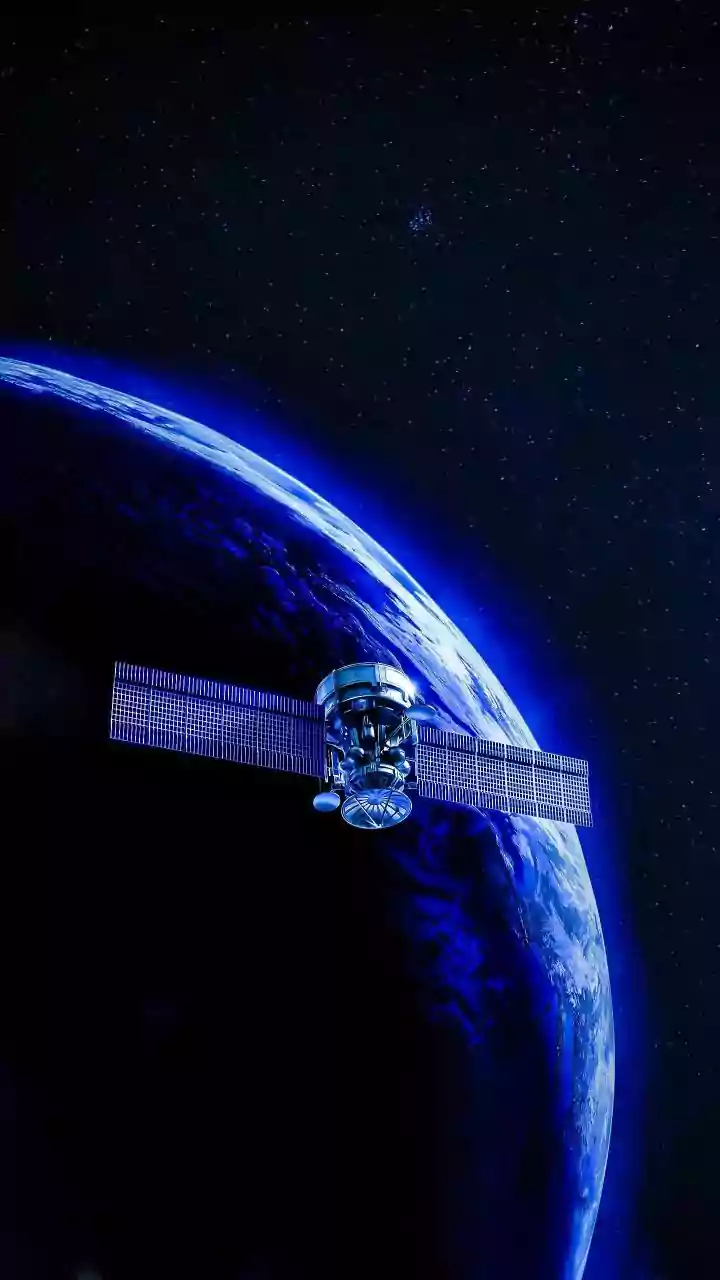
Why take this technology to space? While fiber optic cables can carry quantum signals, they are limited by distance; the signal degrades over a few hundred kilometers. Satellites overcome this entirely. A satellite in low Earth orbit can generate a secure key with a ground station in one country, fly over to another, and generate another key. This creates a secure communication link across continents, something that is extremely difficult to achieve on the ground. A network of such satellites could form the backbone of a future quantum internet, enabling hack-proof communication for critical sectors like finance, defense, energy grids, and government infrastructure.
A Quantum Leap in the Space Race
India's progress places it among a select group of nations competing in a new kind of space race. China is widely seen as a leader, having launched its Micius satellite back in 2016 and using it to demonstrate intercontinental quantum-secured video calls. But others are closing in. Europe plans to launch its Eagle-1 satellite in the near future, while Canada is developing its own QEYSSat mission. The United States is also heavily invested, with government bodies like NASA and the Space Force working on quantum roadmaps and testing quantum sensors to ensure it doesn't fall behind. ISRO's advancements signal that India is a serious contender, aiming to build its own sovereign and secure communications infrastructure for the coming quantum era.