



A New Window on Distant Worlds
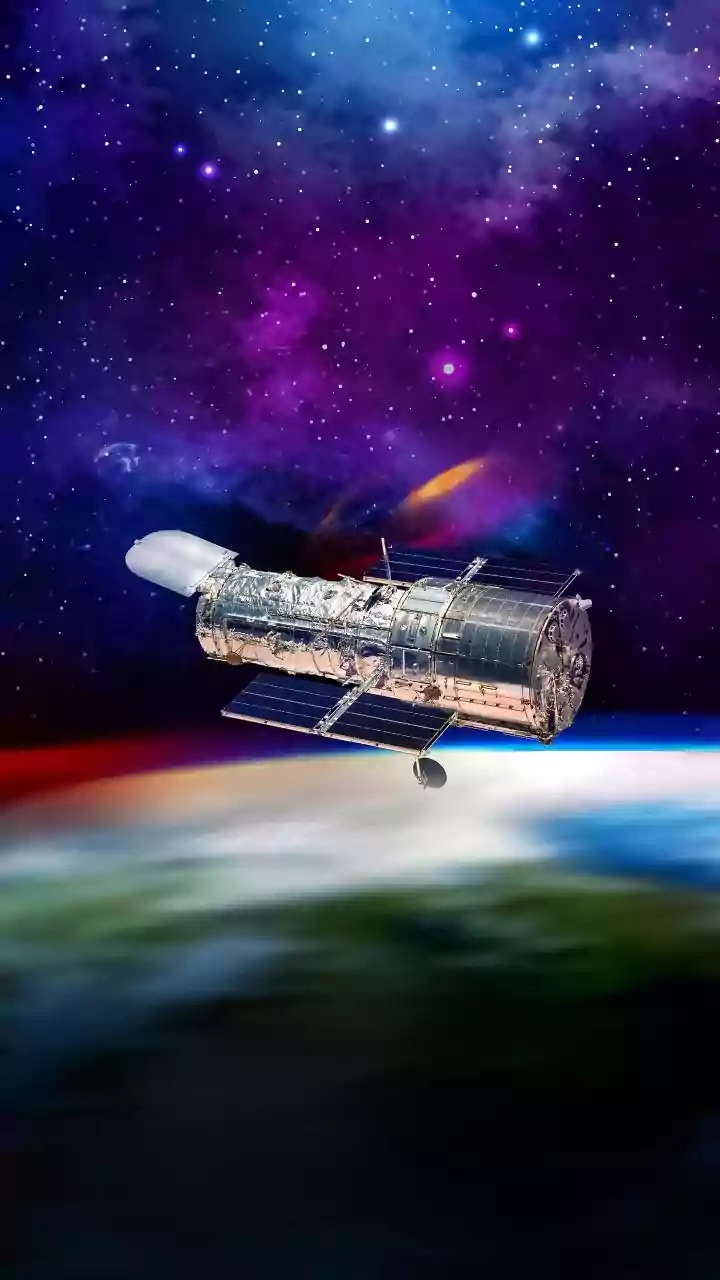
For decades, telescopes like the Hubble have been crucial in discovering thousands of exoplanets, but they often hit a wall—literally. Many promising planets are shrouded in thick layers of haze or clouds that visible light cannot penetrate. This is where
the JWST, with its powerful infrared instruments, changes the game. Infrared light, which we feel as heat, has longer wavelengths that can pierce through these obscuring veils, allowing scientists to finally see what lies beneath. The telescope's ability to operate deep into the infrared spectrum provides a new, transformative window into the physical processes and chemical make-up of these alien atmospheres.
Reading an Atmospheric Barcode
JWST’s primary method for studying an exoplanet’s air is a technique called transmission spectroscopy. As a planet passes in front of its host star, a tiny fraction of the starlight filters through its atmosphere. Molecules in that atmosphere, such as water, methane, or carbon dioxide, absorb very specific wavelengths, or colors, of light. This creates a unique chemical 'barcode' in the star's light spectrum. By capturing this light with its advanced spectrographs, JWST can decipher this barcode and identify precisely which gases are present, even hundreds of light-years away. This technique is so sensitive it can pick up on chemical fingerprints that were previously undetectable.
From 'If' to 'How': Understanding Dynamics
The true revolution brought by JWST is the shift from merely detecting the presence of water to understanding its behaviour—what scientists call 'dynamics'. While previous telescopes could sometimes find faint hints of water, JWST can measure its quantity, temperature, and even its location within the atmosphere. For instance, by measuring the heat a planet emits as it orbits its star, scientists can create temperature maps of its day and night sides. A dramatic temperature difference suggests an atmosphere is either thin or composed of heavier molecules, like water, that don’t circulate heat efficiently. This leap means we are no longer just asking 'Is there water?' but 'How does that water behave?' This is the first step towards charting weather patterns on other worlds.
Case Study: The Steamy World of GJ 1214 b
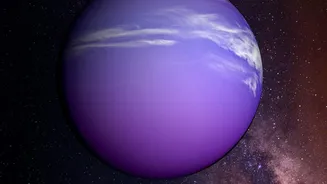
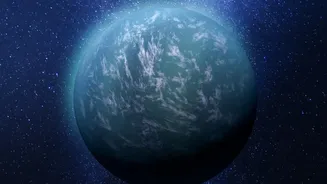
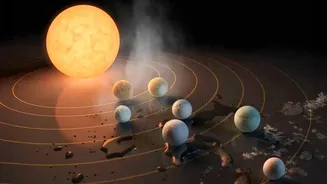
A prime example of JWST's power is its recent observation of GJ 1214 b, a 'mini-Neptune' 40 light-years away that has puzzled astronomers for over a decade. Blanketed in a thick haze, its true nature was a mystery. Using its Mid-Infrared Instrument (MIRI), JWST peered through the fog and revealed an atmosphere likely rich in water vapour. The data indicated a world far too hot to be habitable but showed it was likely a 'steam world'. This breakthrough resolved a long-standing debate and demonstrated JWST's ability to distinguish between different atmospheric models, a task that was impossible before. The findings for GJ 1214 b and other planets like WASP-107b, where sand clouds were also found, are reshaping our understanding of planetary formation and evolution.
The Building Blocks of Habitability
Understanding water vapour dynamics is a critical piece of the puzzle in the search for habitable planets. The presence of water alone isn't enough; for a planet to potentially host life as we know it, it needs liquid water on its surface, which requires a stable climate. By providing detailed information on atmospheric temperature, pressure, and composition, JWST helps scientists model a planet's climate system. These insights allow them to determine if conditions are right for water to exist as a liquid. Furthermore, studying the ratio of different types of water, like 'heavy water', can offer clues about how a planet formed and evolved. Each observation brings us closer to identifying worlds that don’t just have the ingredients for life, but may also have the right environment to support it.