


Peering into Cosmic Nurseries
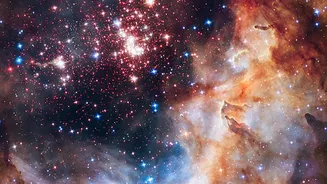
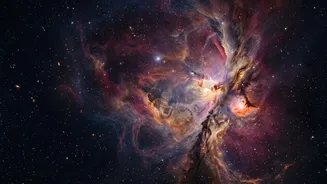
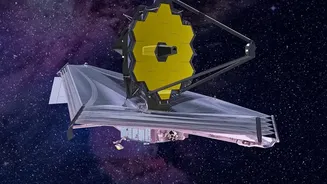
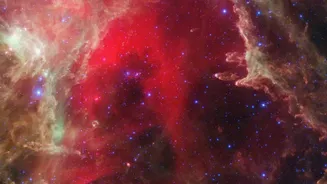
The James Webb Space Telescope has provided some of the most detailed and breathtaking images of stellar nurseries, the vast clouds of gas and dust where stars are born. One of the most famous examples is a region within the Rho Ophiuchi cloud complex,
the closest star-forming region to Earth, located about 390 light-years away. Images from this region reveal around 50 young stars, most no bigger than our own Sun, in various stages of formation. We see glowing clouds of gas, powerful jets of hydrogen shooting out from infant stars, and dense cocoons of dust where protostars are still gathering mass. These images provide the clearest view yet of this brief, chaotic phase of a star's life, giving us a glimpse of what our own solar system might have looked like billions of years ago.
The Power of Infrared Vision
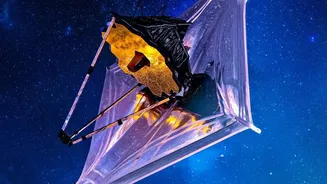
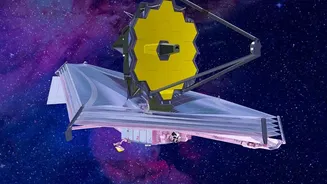
The key to Webb's groundbreaking observations is its ability to see the universe in infrared light. Stellar nurseries are historically difficult to study because they are filled with dense dust clouds that block and scatter visible light, the kind our eyes and telescopes like Hubble primarily see. However, the longer wavelengths of infrared light can penetrate this dusty shroud. This allows JWST to see what is happening inside these clouds, revealing the hidden processes of star formation. The telescope is equipped with specialized instruments, like the Near-Infrared Camera (NIRCam) and the Mid-Infrared Instrument (MIRI), which capture different parts of the infrared spectrum. This capability essentially gives astronomers a new set of eyes to explore a previously invisible universe.
From Dust Grains to Planets
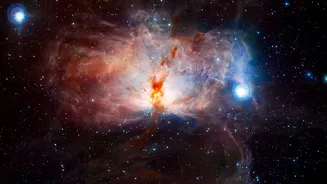
By piercing the dust, Webb is helping to solve fundamental questions about how stars and planets are made. The telescope has captured stunning images of protostars, like L1527, which appear as fiery hourglass shapes. This shape is formed as the young star, hidden in the neck of the hourglass, ejects material and blows away surrounding gas and dust. Webb's instruments can also detect the chemical makeup of these regions, identifying ices and complex organic molecules in the clouds where stars gather mass. It has even tracked how water ice turns to vapor as it gets closer to a young star, a critical step in creating an environment where Earth-like planets might eventually form. Observing these protoplanetary discs—the rotating rings of gas and dust around young stars—gives us direct insight into the building blocks of new solar systems.
Rewriting the Cosmic Story
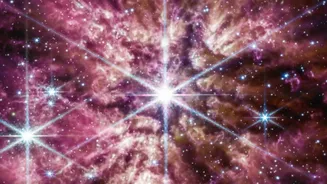
The discoveries from JWST are not just adding details; they are reshaping our understanding of star formation on a galactic scale. By surveying thousands of star clusters in nearby galaxies, astronomers have found that the most massive clusters emerge from their natal clouds much faster than smaller ones, in as little as five million years. This process of clearing away gas, known as stellar feedback, has a huge impact on how a galaxy evolves, as the intense ultraviolet light from these massive new stars can influence other star-forming regions. Each new image from Webb reveals unexpected structures and details, from shockwaves created by infant stars to giant bubbles of gas. These observations are helping scientists refine their simulations and theories about how the universe's most fundamental structures came to be.