



What is an ‘Active’ Black Hole?
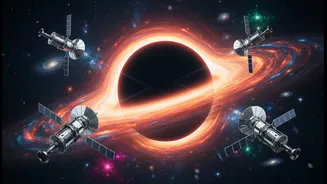
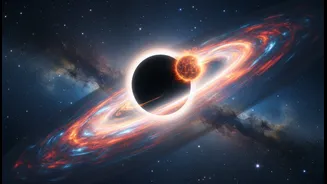
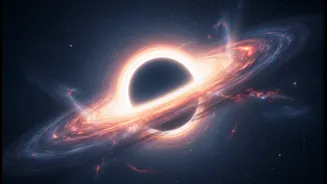
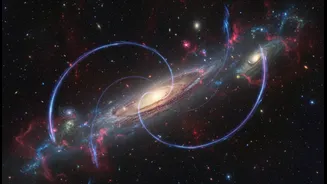
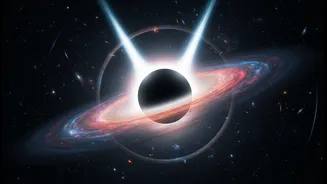
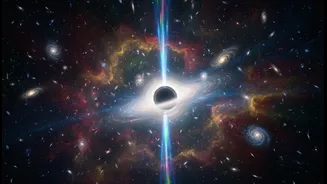
Most supermassive black holes, which lurk at the center of nearly every large galaxy, are dormant and invisible. But when a star or a cloud of gas wanders too close, the black hole's immense gravity tears it apart, pulling the material into a swirling,
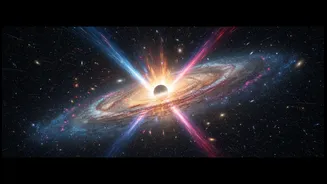
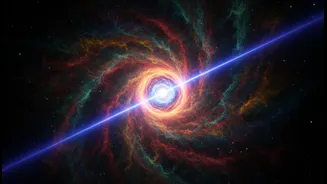
superheated ring called an accretion disk. This process, often called 'activation', turns the black hole into an Active Galactic Nucleus (AGN), one of the most luminous objects in the cosmos. As the material in the disk spirals inward, it gets fantastically hot and emits intense radiation, especially X-rays. It’s this violent, energetic feeding frenzy that makes an otherwise invisible object detectable across billions of light-years.
Listening to a Black Hole's Echoes
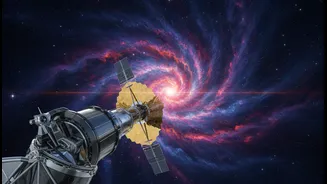
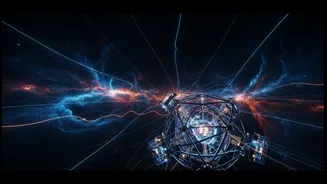
The key to using these active black holes as a gravity probe lies in a phenomenon called X-ray reverberation mapping. Think of it like sonar, but with light. Near the black hole, a mysterious, ultra-bright source of X-rays, known as the corona, flashes and flares. This initial burst of light travels directly to our telescopes, but some of it also shines down onto the accretion disk. This illuminates the disk, causing it to radiate its own X-rays a fraction of a second later, like a delayed echo. By measuring the tiny time delay between the direct flash from the corona and the 'echo' from the disk, astronomers can calculate the distance between them with incredible precision. This technique essentially uses time to measure distances that are far too small to be seen directly, turning light echoes into a cosmic ruler.
A New Test for Einstein's Gravity
This is where things get really interesting. The environment right next to a supermassive black hole is the most extreme laboratory of gravity in the universe. Here, the gravitational forces are so intense that they warp space and time itself, an effect predicted by Albert Einstein's theory of general relativity. The light echoes don't just reveal distance; their properties are twisted and distorted by these extreme gravitational effects. The light's frequency is shifted, and the time it takes to travel is altered in specific ways that depend on the black hole's mass and how fast it's spinning. By carefully analyzing these 'relativistic' echoes, scientists can map the geometry of spacetime right at the edge of the event horizon—the point of no return. This provides a direct, observational test of general relativity in a regime where its effects are undeniable and profound, confirming that gravity behaves as Einstein predicted even under the most extreme conditions.
Why This Cosmic Data Matters
While testing a century-old theory might seem abstract, these findings have huge implications. They confirm that our understanding of gravity holds true across cosmic scales and in the most challenging environments. Furthermore, this technique allows for the most precise measurements ever of black hole mass and spin, two fundamental properties that dictate how these giants influence their host galaxies. When a black hole feeds, it can launch powerful winds and jets that can either trigger or shut down star formation across the entire galaxy, a process known as AGN feedback. Understanding a black hole’s properties helps us understand this crucial link between the growth of galaxies and the supermassive black holes at their centers. These distant, active black holes are not just destroying matter; they are providing the raw data needed to build a more complete picture of our universe.