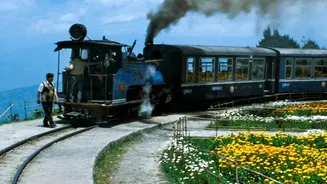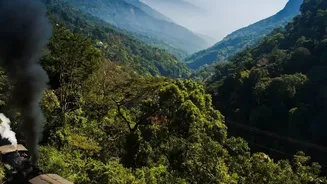









Chugging through misty forests and verdant tea estates, the Nilgiri Mountain Railway is more than a charming 'toy train'. It's a marvel of engineering that conquers Asia's steepest railway line using a brilliant, century-old technology.
A Journey Back in Time
The journey on
the Nilgiri Mountain Railway (NMR) is one of India’s most iconic travel experiences. Affectionately called the 'toy train', this metre-gauge line connects Mettupalayam on the plains with the popular hill station of Udagamandalam (Ooty). The full 46-kilometre trip takes nearly five hours, a deliberately slow pace that allows passengers to soak in panoramic views of the Nilgiri Hills, or 'Blue Mountains'. The train winds its way through 16 tunnels, across 250 bridges, and around 208 sharp curves, offering breathtaking vistas of rocky gorges and lush landscapes. First proposed in 1854 and finally completed in 1908, the railway was a staggering feat of engineering for its time, built to connect the British colonial administration's summer capital in the cool hills. Today, it’s a living piece of history and a UNESCO World Heritage site, celebrated for its bold design and vintage charm.
The Challenge: A Mountain Too Steep
Conventional trains rely on the friction between their steel wheels and the steel rails, a principle known as adhesion. This works perfectly well on flat ground or gentle slopes. However, the Nilgiri mountains presented a formidable obstacle. The ascent from Mettupalayam (326 metres elevation) to Coonoor (1,712 metres elevation) is incredibly steep. Some sections have a gradient as sharp as 1 in 12.5, meaning the track rises one metre for every 12.5 metres of forward travel. For a regular train, this incline is impossible to climb; the wheels would simply spin and slide backwards. The British engineers needed a more robust solution to haul the train up the demanding terrain safely and reliably.
The Solution: A Rack and Pinion System
The ingenious answer to this problem was the 'rack and pinion' system. It is the only railway in India to use this technology. The system is straightforward yet highly effective. A third rail, called a rack, is laid between the two running rails. This rack rail looks like a ladder, with teeth cut into it. The locomotive is fitted with a special gear wheel, known as a pinion, on its underside. This cogged pinion wheel meshes with the teeth of the rack rail. Instead of relying on friction, the engine literally pulls itself up the mountain by climbing this toothed rail, ensuring a positive grip that prevents any slipping, even on the steepest slopes. This technology, specifically the Swiss-designed 'Abt system', was the cutting-edge of mountain railway engineering in the late 19th century and is still in use on the NMR today.
Where the Magic Happens
The rack and pinion system is not used for the entire 46-kilometre journey. It is deployed on the most demanding section of the line, the 19-kilometre stretch between Kallar and Coonoor. The journey from Mettupalayam begins on a conventional adhesion track. Just after the now-closed Kallar station, the toothed rack rail appears, and the locomotive engages its pinion gear. From this point, the train's speed drops to a leisurely 13 km/h as the powerful, specially designed 'X' Class steam locomotives push the carriages up the incline from the rear. Passengers can often feel the distinct mechanical engagement as the cogs lock in, a tangible connection to the engineering that makes the ascent possible. Once the train reaches Coonoor, the rack system ends. From Coonoor to Ooty, the gradient is much gentler, and the journey is completed by a diesel locomotive using conventional adhesion.
A Heritage to Preserve
The Nilgiri Mountain Railway is more than just a tourist attraction; it is a functioning relic of a bygone era of engineering brilliance. In 2005, UNESCO added the NMR to its list of World Heritage Sites as an extension of the Darjeeling Himalayan Railway, collectively known as the Mountain Railways of India. The recognition honours the line as an 'outstanding example of a hill passenger railway' that applied 'bold and ingenious engineering solutions' to the problem of mountain transport. The continued use of vintage steam locomotives, some of which are nearly a century old, adds to its unique character. Maintaining this historic line is a significant undertaking, but its cultural and historical value makes it an irreplaceable treasure, offering a captivating journey through both stunning scenery and engineering history.