




The Sun's Rhythmic Temper
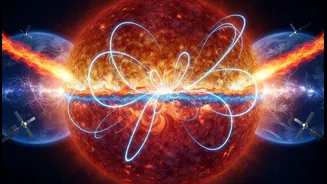
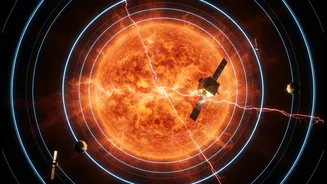
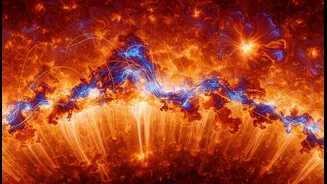
The Sun has a heartbeat, of sorts. Roughly every 11 years, it goes through a cycle of activity, moving from a quiet minimum to a stormy maximum and back again. During its active phase, the Sun produces more sunspots, solar flares, and coronal mass ejections
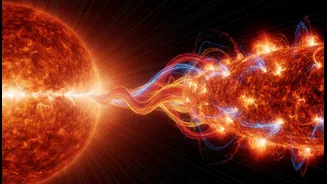
(CMEs)—powerful bursts of plasma and magnetic fields. When these eruptions are aimed at Earth, they can cause what we call space weather. Severe space weather poses a significant threat to our modern, technology-dependent society. It can disrupt GPS signals, damage or destroy crucial satellites, endanger astronauts, and even bring down power grids on the ground. Because the stakes are so high, scientists are intensely focused on forecasting these solar cycles, aiming to predict their timing and intensity with greater accuracy.
A Mysterious Boundary Layer
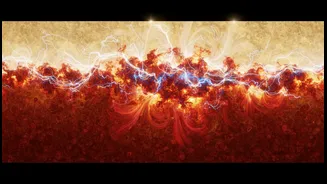
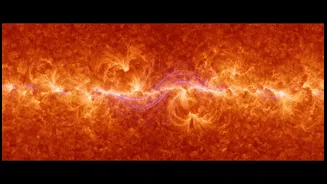
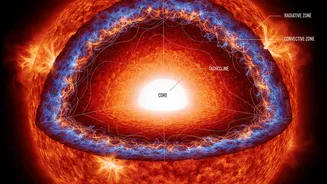
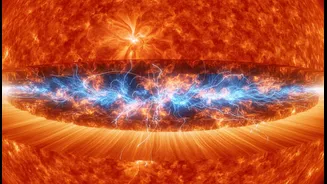
Deep inside the Sun, about 200,000 kilometres below its visible surface, lies a region of critical importance: the tachocline. It's a remarkably thin boundary layer, only about 4% of the Sun's radius thick, separating two distinct zones. Below it is the radiative zone, where energy from the core travels outward via photons, and which rotates like a solid ball. Above it is the turbulent convection zone, a boiling sea of hot gas where different latitudes rotate at different speeds—faster at the equator, slower at the poles. The tachocline is the shear layer where these two different rotation styles meet. This intense shear is believed to be the engine of the solar dynamo, the physical process that generates the Sun's powerful magnetic field. It's here that magnetic field lines are thought to get stretched, twisted, and amplified, eventually leading to the sunspots and solar activity we observe on the surface.
New Clues From Deep Within
For decades, the tachocline was more of a theoretical concept, its properties inferred from models. But using a technique called helioseismology, which studies pressure waves that travel through the Sun much like seismic waves through the Earth, scientists can now map the solar interior with stunning precision. Recent findings have challenged and refined our understanding of this hidden layer. Some studies have indicated the tachocline is not a simple, smooth boundary but may have a more complex shape, bulging outwards at mid-latitudes. Other research using long-term observational data suggests that while the tachocline's thickness and position don't seem to change much with the solar cycle, the intensity of the shear within it does. There's even an ongoing debate in the scientific community, with some recent models suggesting that key dynamo processes might actually begin much closer to the sun's surface, challenging the tachocline's primary role. These new details are crucial pieces of the puzzle.
Rewriting the Solar Playbook
These evolving insights into the tachocline's structure and dynamics have a direct impact on the models used to predict the solar cycle. Current forecasting methods, like the widely used Babcock-Leighton flux-transport models, incorporate the tachocline as a central component for generating the magnetic field. The more accurately these models can represent the physical conditions—the exact shape of the tachocline, the strength of the shear, and how it interacts with plasma flows—the better their predictions will be. For example, if the shear is stronger or weaker during a particular cycle than the model assumes, it could explain why some cycles are more intense than others. Refining the models with the latest helioseismology data means moving from a generalised picture to one that reflects the Sun's specific, changing state. This could significantly improve our ability to forecast the start, peak, and strength of future solar cycles.
Why Better Forecasts Matter for India
For a nation like India, with a growing reliance on space technology and a sophisticated power grid, better space weather forecasting is not just an academic exercise. The Indian Space Research Organisation (ISRO) operates a large fleet of satellites for communication, navigation, and Earth observation, all of which are vulnerable to solar storms. Improved long-term forecasts would give agencies more time to implement protective measures, such as temporarily repositioning satellites or powering down sensitive electronics. It would also help power grid operators prepare for potential geomagnetically induced currents that can overload transformers and cause blackouts. As our world becomes more interconnected and dependent on technology, understanding the deep solar engine that is the tachocline becomes a critical part of ensuring our resilience here on Earth.