





A Landmark Investment in Robotic Touch
Eka Robotics, a startup out of Cambridge, Massachusetts, recently announced a significant milestone: a $150 million Series A funding round. The investment was co-led by prominent venture capital firms Andreessen Horowitz (a16z) and F-Prime, with participation
from previous and new investors including Samsung Next. This substantial financial injection values the young company at an impressive $1.45 billion and signals massive confidence from the tech industry in Eka's mission to solve one of robotics' most persistent challenges: dexterous manipulation. The goal is to build general-purpose robots that can finally bridge the gap between performing in a lab and delivering real value in the unpredictable environments of a factory or warehouse.
The Challenge of a Gentle, Intelligent Grip
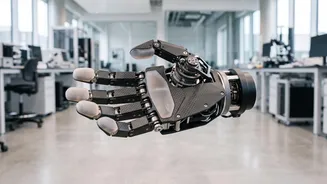
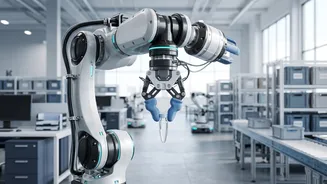
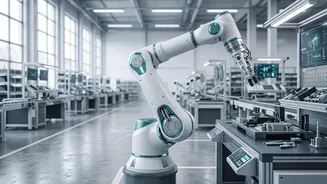
Most physical work across global industries, from logistics to electronics assembly, still relies on human hands. This is because traditional robots lack the ability to handle variation and delicacy. They are programmed for precision in highly structured settings but struggle when an object is soft, slippery, or not perfectly positioned. This is what experts call the 'last millimeter problem'. Eka's approach is to give robots a sense of 'touch' that works in harmony with vision. By combining sight with force-feedback sensors, the robot can feel if a grasp is slipping or if it encounters resistance, and adjust its actions in real-time. This is a fundamental shift from simply telling a robot where to go, to allowing it to understand and interact with the physical world.
How the 'Vision-Force-Action' Model Works
Instead of relying on humans to demonstrate tasks, Eka trains its robots in a physics simulator using a technique called reinforcement learning. In this virtual world, the robot can practice a task millions of times, experiencing thousands of hours of 'work' in just minutes and learning from trial and error under countless different conditions. This proprietary 'Vision-Force-Action' (VFA) model allows the robot to build an intuition for physics. It learns how firmly to grasp a soft fruit or how to wiggle a wire into a connector, not by mimicking a person, but by understanding the forces at play. This approach allows the learning to scale with computing power, making it a more efficient path toward creating a truly adaptable robotic workforce.
Transforming Industries from Warehouses to Assembly Lines
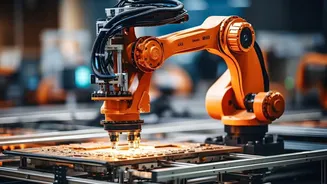
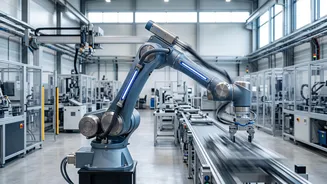
The applications for this technology are vast and transformative, particularly for India's growing manufacturing, e-commerce, and healthcare sectors. In logistics and e-commerce fulfillment centers, robots equipped with Eka's technology could handle a massive variety of products, from soft clothing to fragile electronics, at speeds far exceeding human capability. Eka reports its robots can already achieve up to 1,500 picks per hour, more than double the average human rate. In electronics manufacturing, these robots could perform intricate assembly tasks like inserting delicate components and connecting wires. Even agriculture could benefit, with robots capable of harvesting soft fruits and vegetables without causing damage. This move towards intelligent automation promises to boost productivity, improve safety by taking humans out of hazardous roles, and address labor shortages in key industries.