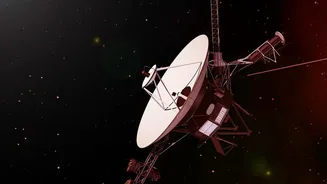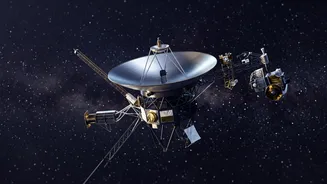



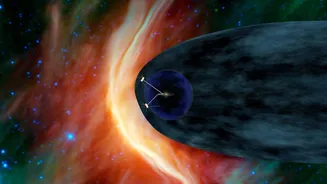

On November 18, after nearly 50 years of silent travel, humanity's most distant envoy, Voyager 1, will reach a milestone that redefines distance: it will be one full light-day away from Earth. Here’s what that incredible distance means.
A New Unit of Measurement
What exactly is
a light-day? It isn't a measure of time, but of distance. It's the total distance that a beam of light, the fastest thing in the universe, travels in a 24-hour period. That equates to approximately 25.9 billion kilometres. To put that into perspective, light from the sun takes about eight minutes to reach us. A radio signal sent to Mars can take up to 22 minutes. On November 18, a signal sent from Earth will take a full 24 hours to reach Voyager 1. This means a simple 'hello' and response would require a two-day round trip. This milestone highlights not just the spacecraft's immense distance, but the profound communication delays involved in deep space exploration.
An Unexpectedly Long Journey
Launched on September 5, 1977, Voyager 1 was part of a dual-spacecraft program designed to study the outer planets. Its original mission was only supposed to last five years. Though launched 16 days after its twin, Voyager 2, it was put on a faster, shorter trajectory. It performed historic flybys of Jupiter in 1979 and Saturn in 1980, revealing the first active volcanoes beyond Earth on Jupiter's moon Io and the complex nature of Saturn's rings. After its planetary mission, it was flung towards the edge of the solar system. In August 2012, it made history by becoming the first human-made object to enter interstellar space, crossing the boundary where the sun's influence ends.
A Fading Signal from the Void
At 25.9 billion kilometres away, keeping in touch is a monumental challenge. Voyager 1 communicates with Earth via NASA's Deep Space Network, but its power source, a set of radioisotope thermoelectric generators, is slowly fading. The plutonium that powers it loses about four watts of energy a year. Engineers have been shutting down instruments and heaters for years to conserve power, and in 2026, they performed complex manoeuvres to extend the life of the remaining science instruments. Despite these efforts and recent communication glitches, NASA hopes to keep receiving data from the probe into the 2030s, though its signal will eventually become too faint to detect.
A Message in a Cosmic Bottle
Beyond its scientific mission, Voyager 1 is also a cultural ambassador. Attached to its side is a 12 inch, gold plated copper disk known as the Golden Record. Curated by a committee led by astronomer Carl Sagan, it's a message in a bottle intended for any intelligent life that might one day find the silent probe. The record contains 115 images, a variety of natural sounds from Earth, spoken greetings in 55 languages, and 90 minutes of music from around the world—from Bach to Chuck Berry. Before its cameras were shut down in 1990 to save power, it turned one last time to take a picture of Earth from $6.4$ billion kilometres away, the famous 'Pale Blue Dot' image.
Voyager $1$ is travelling at nearly $6$l$,$000 kilometres per hour relative to the sun. Even at this speed, it took nearly five decades to travel the distance of a single light-$d$ay. Its journey is far from over. In about $300$ years, it will reach the inner edge of the Oort Cloud, a vast, theoretical sphere of icy objects surrounding the solar system. And in about $40$,$000 years, it will pass within $1.$7 light-$y$ears of a faint star called Gliese $445$. Though it will fall silent long before then, Voyager $1$ will continue its journey through the Milky Way for millions of years, a silent testament to human curiosity.