




The Challenge of a 'Do-Anything' Robot
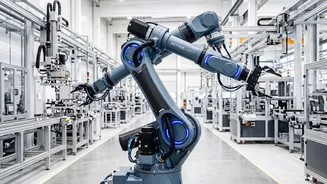
In the world of automation, most robots are single-task masters. A robotic arm in a car factory can weld thousands of times with perfect precision, but it can’t be asked to pack a box of delicate mangoes. This limitation has created a significant gap
between the robots we have and the versatile 'helper' robots of science fiction. The goal has always been to create a general-purpose robot: a machine that can adapt to various tasks in changing environments without needing a complete overhaul. Traditional robots operate on pre-programmed instructions, which works well in structured settings but fails in the unpredictable real world. Addressing this requires a leap in artificial intelligence, moving from robots that simply follow commands to robots that can perceive, understand, and interact with their surroundings in a more intuitive, human-like way.
Eka Robotics and a New Vision for AI
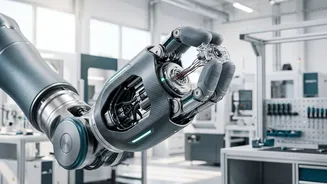
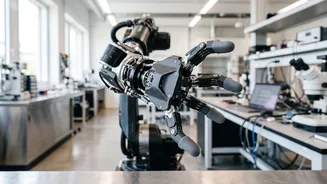
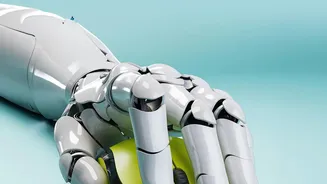
Enter Eka Robotics, a US-based startup that recently made headlines by securing $150 million in funding to scale its revolutionary approach. Founded by researchers from MIT and Google DeepMind, Eka is not just building another robot; it is building the 'brain' that could power a new era of automation. The company’s core innovation is a model they call Vision-Force-Action (VFA). While most robots rely solely on cameras (vision) to see and locate objects, Eka's system adds a crucial third sense: force. By integrating advanced force sensors into the robot's gripper, the machine can 'feel' an object, understanding its texture, fragility, and how it responds to pressure. This allows the robot to build an intuition for physics, much like a human does. It’s the difference between seeing a lightbulb and knowing precisely how much force to apply to screw it in without breaking it.
Learning in a Virtual World
One of the most significant hurdles in training adaptable robots is providing them with enough experience to handle countless real-world scenarios. Teaching a robot by physically showing it how to perform a task is slow and limited. Eka Robotics bypasses this problem by using large-scale reinforcement learning within a physics simulator. Inside this virtual environment, the AI can practice tasks for thousands of hours in just minutes, experimenting with different objects, environments, and physical conditions through trial and error. This method allows the robot to learn from its mistakes and successes at a superhuman pace, developing a robust understanding of how to manipulate objects without ever needing a human to demonstrate the task. The company claims this process, which cuts out the need for human training data, is the key to achieving performance that can surpass human capabilities.
From Superhuman Speed to Real-World Impact
The results are impressive. Eka reports its robots can perform pick-and-place tasks at a rate of 1,500 items per hour, more than double the average human speed of around 600 items per hour, with over 95% accuracy. Crucially, these robots can handle objects they have never encountered before, from delicate produce to slippery industrial parts, without being retrained. For industries in India, from manufacturing and e-commerce warehousing to logistics and agriculture, the implications are enormous. Imagine warehouses where robots can sort a diverse and ever-changing inventory of products, or factories where a single robotic arm can switch seamlessly between assembling electronics and packing the final product. This level of flexible automation could address labour shortages, boost productivity, and allow businesses to adapt more quickly to changing market demands.
The Road Ahead for Adaptable Automation
While Eka's technology represents a major step forward, the journey toward truly universal, do-anything robots is still in its early stages. The next major test is to prove this technology can perform reliably not just in lab settings, but in the chaotic and demanding environments of real-world industrial operations, running 24/7 without failure. However, the breakthrough of combining vision with a sense of touch is solving one of the most stubborn problems in robotics: dexterous manipulation. By creating a system that learns the physics of its environment, Eka Robotics is laying the groundwork for machines that are not just tools, but true partners in physical work.