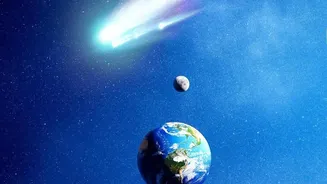




It’s been a faithful, if distant, companion for years, but now it’s time to say goodbye. Astronomers are tracking asteroid 2026 QQ8 as its long, looping dance around our planet comes to a close, offering a final glimpse into its cosmic history.
A Cosmic Companion We Barely Knew
For the
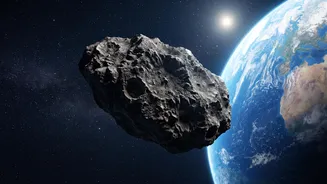
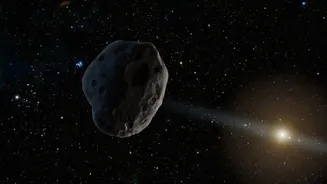
past several decades, a small asteroid known as 2026 QQ8 has been Earth's secret companion. Roughly the size of a small office building, it has been moving in a complex, corkscrew-like pattern relative to our planet. While it never posed a threat, its presence has been a source of fascination for scientists who study the intricate gravitational dynamics of our solar system. Discovered earlier this decade by automated sky surveys designed to detect near-Earth objects, 2026 QQ8 was quickly identified not as a typical asteroid just passing by, but as something much rarer: a quasi-satellite. These objects are gravitationally tethered to a planet in a loose, temporary arrangement, making them fascinating natural laboratories for understanding orbital mechanics.
Not a Moon, but a Quasi-Satellite
So, what exactly is a quasi-satellite? Unlike our Moon, which is permanently bound by Earth's gravity, a quasi-satellite primarily orbits the Sun. However, its orbital period is almost identical to Earth's, meaning it completes one journey around the Sun in roughly 365 days. This 1:1 orbital resonance keeps it in our general vicinity. From our perspective on Earth, the asteroid appears to trace a strange, elongated path around us over the course of a year. It’s a gravitational illusion of sorts. The asteroid isn't truly orbiting Earth; it’s our co-pilot on a shared journey around the Sun. This relationship is temporary. Over centuries, the subtle gravitational pulls from other planets, especially Jupiter, will gently nudge the asteroid, causing its orbit to drift until the synchronization with Earth is broken.
The Long Goodbye
For 2026 QQ8, that moment of departure is now arriving. Decades of careful tracking have allowed astronomers to predict this event with remarkable precision. The asteroid's orbit is subtly changing, and it is beginning to drift away from the delicate gravitational balance it has maintained with Earth. Over the next few years, it will transition from its quasi-satellite path into what is known as a 'horseshoe orbit'. This means that instead of looping around Earth, it will trace a much larger, U-shaped path along Earth's orbit, sometimes moving ahead of our planet and sometimes falling behind. It will no longer be our constant companion, but it will remain a near-Earth asteroid, destined to make distant flybys for centuries to come. Such transitions are a natural part of the life cycle for these objects.
Earth's Other Temporary Friends
2026 QQ8 is not the first temporary visitor Earth has had. Astronomers have identified several other quasi-satellites over the years, each with its own unique story. One of the most stable and well-studied is Kamoʻoalewa (also known as 2016 HO3), an object that has been a quasi-satellite for nearly a century and will remain so for centuries more. In a fascinating twist, some research suggests Kamoʻoalewa may not be a typical asteroid at all, but a fragment of our own Moon, blasted into space by an ancient impact. Other objects, like 2020 CD3 and 2006 RH120, have become true (but very temporary) 'minimoons', briefly captured into orbit directly around Earth before escaping again. These celestial visitors come in many forms, reminding us that our planet's gravitational influence is more complex than it seems.
Why We Study These Rocks
Observing objects like 2026 QQ8 is more than just an academic exercise. These near-Earth asteroids are pristine relics from the formation of the solar system 4.6 billion years ago. Studying their composition can tell us about the raw materials that built planets, including our own. Some scientists believe that asteroids and comets may have delivered water and the basic building blocks of life to a young Earth. Furthermore, understanding the orbits of these objects is a crucial part of planetary defense. By tracking their paths and learning what they're made of, we can better predict any potential impact threats and develop strategies to deflect them if necessary, as demonstrated by NASA's DART mission in 2022.