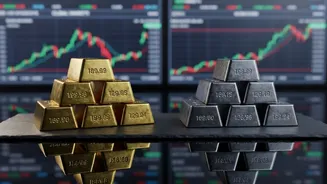







In the world of precious metals, one simple number offers a powerful glimpse into market sentiment. The gold-to-silver ratio is a key indicator for investors, revealing the relative value of these two ancient assets.
What Exactly Is the Ratio?
The gold-to-silver ratio is a straightforward
calculation: it's the current price of gold divided by the current price of silver. The resulting number tells you precisely how many ounces of silver are needed to purchase one single ounce of gold. For instance, if gold is trading at $3,600 an ounce and silver is at $45 an ounce, the ratio would be 80:1. This means you would need 80 ounces of silver to buy one ounce of gold. Because the prices of both metals are constantly in flux, this ratio changes throughout the day, providing a real-time snapshot of their relative values.
A Glimpse at the Current Landscape
As of late November 2026, the gold-to-silver ratio has seen significant movement. Some market data shows the ratio hovering around 83:1 to 85:1, while other analyses from earlier in the month noted it at approximately 79:1. This volatility is not unusual; 2026 has been a dramatic year for the ratio, which fell to as low as 46:1 in January before rebounding. This recent elevation places it above the 50-year average, which stands at about 63:1, suggesting gold's value has been strong relative to silver. For context, modern free-market trading has often seen the ratio trade in a range between 50:1 and 80:1.
A Journey Through History
The relationship between gold and silver is ancient. In Roman times, the ratio was fixed at around 12:1. For much of the 19th century, it remained low, often near 15:1 or 16:1. The 20th century introduced far more volatility. The ratio climbed during periods of economic stress, hitting a peak of 98:1 before World War II. It reached its all-time high during the economic uncertainty of the COVID-19 pandemic in March 2020, soaring to over 124:1 as investors rushed to gold as a safe-haven asset. Conversely, the ratio has also seen dramatic lows, such as dipping to around 17:1 in 1980. This historical context shows that while the ratio fluctuates, extreme highs and lows are often tied to major global events.
How Investors Interpret the Signals
Investors use the ratio as a barometer for market sentiment and relative value. A high ratio, generally considered to be above 80:1, suggests that silver may be undervalued compared to gold. This can happen during economic crises when investors prefer gold's reputation as the ultimate safe haven, causing its price to rise faster than silver's. On the other hand, a low ratio, often seen as below 50:1, implies that silver is relatively expensive or that gold might be undervalued. This can occur during periods of strong economic growth, as silver's extensive industrial applications in electronics, solar technology, and manufacturing drive up demand.
A Tool in the Investor's Playbook
Traders can use these signals to inform their strategy. A common approach is to buy silver when the ratio is historically high, with the expectation that silver will eventually 'catch up' to gold, causing the ratio to fall. Conversely, when the ratio is low, investors might consider selling silver and buying gold. This strategy, known as mean reversion, is based on the idea that the ratio will eventually return to its historical average. Some investors even use a defined rule, such as shifting into silver when the ratio exceeds 80 and back into gold when it nears 50. It is used as a tool for rebalancing a portfolio and making disciplined, logical decisions rather than emotional ones.
Important Considerations and Limits
While useful, the gold-to-silver ratio is not a crystal ball. It is an indicator, not a definitive predictor of future price movements. A high ratio doesn't guarantee that silver's price will rise, nor does a low ratio mean gold is certain to outperform. The ratio can remain at extreme levels for extended periods. Furthermore, the two metals have different market dynamics. Gold is primarily an investment and a store of value. Silver, while also a precious metal, has significant industrial demand that ties its fate more closely to the health of the global economy. Therefore, investors should use the ratio as one tool among many, considering it alongside broader economic trends, monetary policy, and their own investment goals.