




A Cosmic Anomaly
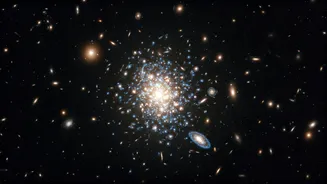
Imagine looking back in time by 10.4 billion years. The universe you would see is only about 3.3 billion years old, a chaotic and busy period that astronomers call “cosmic noon,” when star formation was at its peak. In this era, you’d expect to find young,
messy groups of galaxies just starting to come together. But that’s not what we see with XLSSC 122. Instead, it appears as a surprisingly mature and organized galaxy cluster, more like the ones we see in the modern universe. First spotted in 2014, its advanced development for such an early time was already intriguing. It was a cosmic toddler that looked and acted like a fully-grown adult, presenting a significant puzzle for scientists.
The Webb Telescope’s Sharp Eye
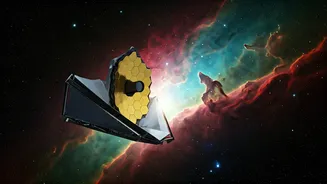
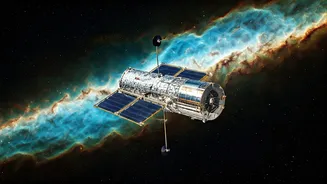
For years, XLSSC 122 remained an interesting but somewhat blurry puzzle. Even the powerful Hubble Space Telescope, while confirming its distance and mature properties, couldn’t see the whole picture. The game changed with the James Webb Space Telescope (JWST). With its unparalleled infrared vision, JWST peered at the cluster and revealed what had been hidden: giant, distorted arcs of light curving around the cluster’s core. This was a 'wow' moment for astronomers. The faint arcs, invisible to previous observatories, were the tell-tale sign of a phenomenon known as strong gravitational lensing, and their discovery unlocked a new level of understanding.
Einstein's Lens in Action
Gravitational lensing was first predicted by Albert Einstein, who theorised that massive objects could warp the fabric of spacetime, causing light to bend around them. XLSSC 122 is so massive that its gravity acts like a natural telescope, bending and magnifying the light from even more distant galaxies located behind it. The arcs seen by JWST are the distorted images of those background galaxies. This discovery makes XLSSC 122 the most distant galaxy cluster ever confirmed to act as a strong gravitational lens. This dual role is incredibly useful: scientists can study the cluster itself while also using its magnifying power to get a boosted view of the even earlier universe.
Weighing the Invisible
The true power of gravitational lensing is that it allows astronomers to weigh a galaxy cluster and, crucially, map its invisible components. The vast majority of a cluster's mass is not in the stars and gas we can see, but in an invisible substance called dark matter. It is this immense dark matter scaffold that provides most of the gravitational muscle for lensing. By analysing the shape and location of the lensed arcs, scientists were able to precisely measure the mass distribution within XLSSC 122. The results confirmed their suspicions: the cluster has an exceptionally dense and concentrated core of dark matter, far more so than our standard models of cosmology would predict for that cosmic era.
Rewriting Cosmic History
So, what does it mean to find such a heavyweight so early in the universe? It suggests that the process of building the universe's largest structures may have happened much faster than we thought. The standard cosmological model, known as Lambda-CDM, generally predicts a slower, more gradual assembly of galaxy clusters. XLSSC 122 challenges this picture, hinting that the early universe was capable of forming massive, concentrated halos of dark matter much more rapidly. As one researcher noted, discovering this object pushes our cosmological models. It’s a beautiful problem to have, forcing scientists to refine their theories to account for this precocious cosmic giant.