


Listening for Gravity's Whisper
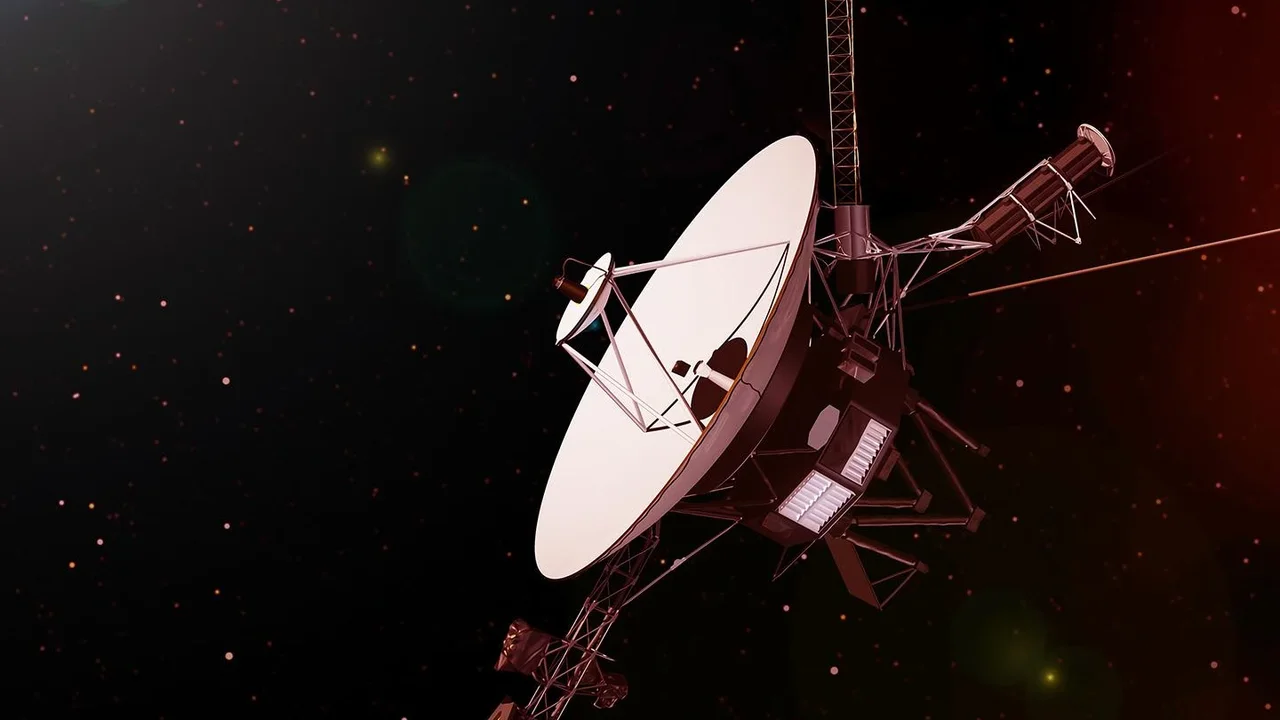
To be clear, spacecraft don't perform 'scans' for gravity in the way a hospital scanner creates an image. The process is far more subtle and clever. It's all about listening to the conversation between a spacecraft and mission controllers on Earth. As
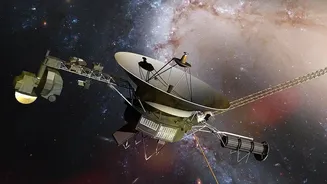
a probe like Cassini (for Saturn's moon Enceladus) or the upcoming Europa Clipper (for Jupiter's moon Europa) flies past its target, scientists on Earth track its radio signal with incredible precision. This signal is the lifeline, carrying data, but it also serves as a delicate scientific instrument itself. The force of gravity from the moon pulls on the spacecraft, causing it to speed up or slow down by a minuscule amount. This change in speed, however tiny, alters the frequency of the radio signal sent back to Earth—a phenomenon known as the Doppler effect. It’s the same reason a fire truck's siren seems to change pitch as it passes you. By measuring this Doppler shift, scientists can map the gravity field of the moon below.
Reading Between the Gravitational Lines
Every object with mass exerts a gravitational pull. A solid, uniform sphere would have a perfectly even gravity field. But celestial bodies are rarely that simple. They have denser cores, lighter crusts, mountains, and valleys, all of which create tiny variations in the local gravity. A spacecraft flying over a massive, dense mountain will be pulled slightly more, and speed up, compared to when it flies over a less-dense plain. For icy moons like Enceladus and Europa, scientists had models of what the gravity field should look like if the moon were solid ice and rock all the way through. When probes like Cassini flew past Enceladus, the Doppler data revealed something was different. The gravitational pull over certain areas, particularly the south pole, was weaker than predicted for a solid body. This pointed to the presence of something less dense than solid ice or rock hidden beneath the surface. That less-dense material was a vast, liquid water ocean.
The Wobble That Gives It Away
Gravity measurements also provided another key piece of evidence. For an ocean to exist, the moon's outer ice shell can't be frozen solid to its rocky core. There must be a liquid layer in between allowing the shell to move independently. Gravity data helped confirm this is exactly what's happening. Researchers analyzed how the tiny moon Enceladus wobbles slightly as it orbits the immense gravitational pull of Saturn. They found the magnitude of this wobble, or libration, could only be explained if the icy crust was decoupled from the core. If the moon were solid, the wobble would be much smaller. The only way for the shell to have that much 'slosh' is if it's floating on a global ocean, allowing it to move more freely. This independent line of evidence, combined with the gravity field anomalies, built an undeniable case for a global subsurface ocean.
Future Missions and Finer Details
The discoveries at Enceladus and Jupiter's moon Europa, first hinted at by the Galileo mission, have revolutionized planetary science. They've shown that the ingredients for life—liquid water, energy, and chemical building blocks—could be present in our own cosmic backyard. Future missions are designed to double down on these techniques. NASA's Europa Clipper, which launched in October 2024, is set to arrive at the Jupiter system in 2030. It will perform dozens of close flybys of Europa, using its sophisticated telecommunications system for a dedicated gravity and radio science experiment. By making repeated and precise measurements of Europa's gravity field as it flexes under Jupiter's immense tidal forces, scientists will be able to create a detailed map of the ocean. This could help determine the ocean's depth, its salinity, and even pinpoint areas where the ice shell is thinnest—potential targets for future landers.