



The Vocal Toolkit
Unlike humans who use a larynx and vocal cords at the top of their windpipe, parrots produce sound using a special organ called the syrinx. This vocal organ is located deep in a bird's chest, at the base of the trachea where it splits into the two bronchi
leading to the lungs. Sound is generated when air from the lungs flows past highly flexible tissues called tympaniform membranes, causing them to vibrate. By using a complex network of tiny muscles to minutely adjust the tension on the syrinx, a parrot can manipulate pitch, tone, and volume with incredible speed and precision. Some birds can even control the two sides of their syrinx independently, allowing them to produce multiple sounds at once, which helps them recreate the complex harmonics of a human voice. Their thick, muscular tongues also play a crucial role, shaping these sounds to form recognisable words, much like our tongues shape vowels and consonants.
A Brain Wired for Sound
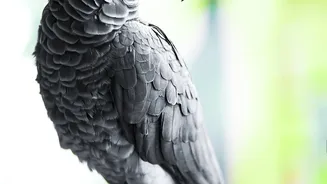
A parrot's vocal talent isn't just about anatomy; it's profoundly neurological. Parrots are among a select group of animals known as 'vocal learners', meaning they can imitate new sounds they hear. Research led by Duke University has shown that parrot brains have a unique structure compared to other vocal-learning birds like songbirds and hummingbirds. While all these birds have defined vocal-learning centres in the brain, often called 'cores', parrots have an additional structure: a 'shell' or outer ring system around these cores. This 'song-system-within-a-song-system' is believed to be the key to their advanced mimicry skills. Scientists found that the shells are relatively larger in parrot species known for being excellent talkers, such as the African Grey. This specialized neural architecture gives them the significant brainpower needed to process complex auditory information and then coordinate the precise muscle movements required for imitation.
Why They Talk: A Social Connection
So, why do parrots bother to copy us? The primary driver is social. In the wild, parrots are highly social flock animals that use shared calls and 'catchphrases' to communicate and identify who belongs to their group. When a parrot lives in a human household, its human family becomes its flock. Mimicking human speech is their way of bonding, fitting in, and interacting with the most important beings in their lives. They are not just randomly copying noises; they are actively trying to participate in the social dynamics of their environment. This is why parrots are often drawn to words spoken with enthusiasm or emotion—they are picking up on social cues and trying to be part of the conversation. The desire to talk is fundamentally a desire to connect.
Do They Understand What They Say?
This is the most debated question. While most parrots are mimicking sounds without understanding their abstract meaning, research has shown they can go far beyond simple repetition. The most famous example is an African Grey parrot named Alex, who was studied for 30 years by Dr. Irene Pepperberg. Alex didn't just mimic; he learned to use over 100 words to identify objects, shapes, colours, and quantities. He could answer questions, understand concepts like 'same' and 'different', and even combined words to describe new things—he once called an apple a 'banerry', thought to be a mix of 'banana' and 'cherry'. While Dr. Pepperberg was careful not to claim Alex used 'language' in the human sense, his abilities showed that parrots can learn to associate sounds with specific meanings and use them contextually. Alex's intelligence was compared to that of a five-year-old child in some intellectual respects, proving that there can be remarkable comprehension behind the chatter.