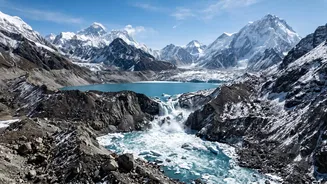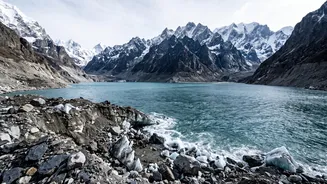







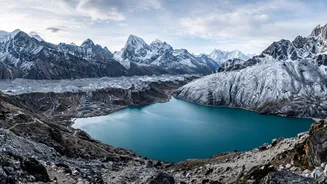
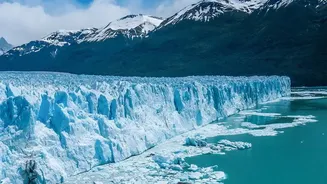

The Himalayas, often called the 'Third Pole', are a lifeline for nearly two billion people. But as global temperatures rise, a new and devastating threat is growing within its icy peaks, prompting urgent warnings from the United Nations.
What Are Glacial Lake Outburst Floods?
A Glacial Lake
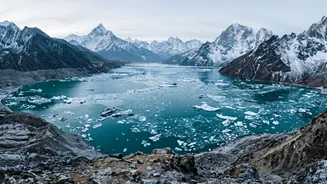
Outburst Flood, or GLOF, is a sudden and catastrophic release of water from a lake formed by melting glaciers. As glaciers retreat due to warming, they leave behind vast depressions that fill with meltwater. These lakes are often dammed by unstable natural barriers of ice and moraine (rock and debris). When this natural dam fails, it can release an immense volume of water in a matter of hours. Triggers can include avalanches of rock or ice falling into the lake, creating a massive displacement wave, or simply the build-up of water pressure. The resulting flood is no ordinary one; it's a terrifying torrent of water, mud, rocks, and ice that can obliterate entire villages, roads, bridges, and critical infrastructure like hydropower dams far downstream.
A 'Severe Risk' for Millions
Recent UN-backed reports have sounded the alarm, highlighting that mountain regions like the Himalayas are warming much faster than the global average. This accelerated melting is causing glacial lakes to grow in both number and size, increasing the instability of the entire system. A UN official has warned that millions of people living in the river basins downstream face 'severe risks' from these events. A pre-publication UN-led global report noted that between 1835 and 2025, India recorded the highest number of deaths from GLOFs among eight countries in the Hindu Kush Himalaya region. The frequency of these events has increased dramatically, rising fivefold since 1950.
India's Vulnerable Himalayan States
The threat is not abstract; it's a clear and present danger for India's Himalayan states. In 2025, a scientific assessment identified 56 glacial lakes across the Indian Himalayas as being at 'very high risk' of causing an outburst flood. States like Sikkim, Himachal Pradesh, Uttarakhand, and Arunachal Pradesh are on the front lines. The catastrophic 2023 flood in Sikkim, which was triggered by the breach of the South Lhonak glacial lake, killed over 50 people and washed away a major hydropower dam, serving as a devastating recent example. Just recently, in late October 2026, a GLOF from Sintaphu Lake in Bhutan triggered alerts and evacuations in downstream West Bengal and Assam, demonstrating the trans-boundary nature of this threat.
The Race to Mitigate a Growing Danger
Responding to this escalating crisis is a monumental challenge. Efforts are underway to identify the most dangerous lakes and implement mitigation strategies. This includes monitoring lake water levels with sensors and satellite imagery, and in some cases, undertaking complex engineering projects to drain or siphon water from high-risk lakes to reduce pressure on their natural dams. The Indian government has approved the National Glacial Lake Outburst Flood Risk Mitigation Project, allocating funds to Arunachal Pradesh, Himachal Pradesh, Sikkim, and Uttarakhand for this purpose. However, a UN official noted that technology and preventative measures struggle to keep pace with the scale of the threat, warning that even robust defences can be overwhelmed by the sheer force of a major GLOF. This makes robust, people-centric early warning systems that reach the last mile absolutely critical to saving lives.