







What is the Cold Atom Lab?
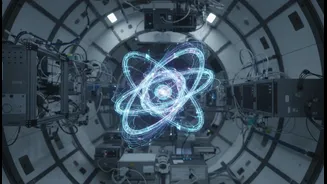
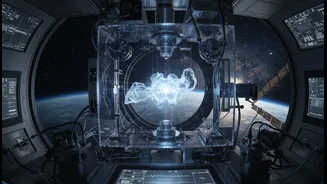
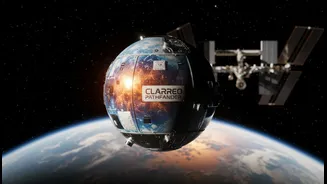
The Cold Atom Laboratory (CAL) is a NASA facility on the International Space Station (ISS) that was launched in 2018. Remotely operated by scientists at the Jet Propulsion Laboratory on Earth, it is designed to study the fundamental nature of atoms in a way
that simply isn't possible on the ground. The key is the microgravity environment of space. On Earth, gravity's constant pull complicates and limits sensitive quantum experiments. By performing these experiments in orbit, scientists can observe delicate quantum phenomena for far longer periods, unlocking new avenues of research.
The Science of Absolute Zero
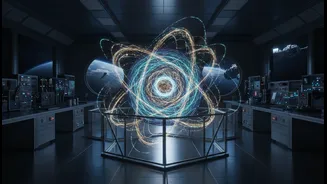
The lab's primary function is to cool atoms down to temperatures just a fraction of a degree above absolute zero, the coldest temperature theoretically possible. This is colder than any naturally occurring spot in the universe. To achieve this, the CAL uses a sophisticated system of lasers and magnetic fields. Lasers are fired at a cloud of atoms, such as rubidium, from all directions. Through a process called Doppler cooling, photons from the lasers are absorbed by the atoms, slowing them down and drastically reducing their kinetic energy—which is, by definition, cooling them. This process brings the atoms to a near standstill, allowing their strange quantum properties to emerge.
Creating a Fifth State of Matter
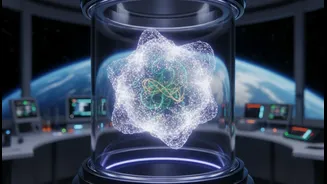
When atoms get this cold, they can enter a unique state of matter called a Bose-Einstein Condensate (BEC). First predicted by Albert Einstein in the 1920s, a BEC forms when atoms become so cold and slow that they lose their individual identities and begin to behave as a single collective entity, often described as a 'super atom' or a macroscopic matter wave. On Earth, gravity quickly pulls these fragile condensates apart. In the microgravity of the ISS, BECs can be studied for much longer, from milliseconds to several seconds. This extended observation time is crucial for making the precise measurements needed for next-generation technologies.
Advancing Quantum Navigation
One of the most promising applications of cold atom technology is in inertial navigation. Current navigation systems, from our phones to airplanes, often rely on GPS. When GPS is unavailable (like underwater, underground, or in deep space), they use classical accelerometers, which can drift and accumulate errors over time. Quantum sensors based on atom interferometry offer a solution. Because every atom of an element is identical, sensors built with them don't drift or decay. These devices use lasers to split and recombine the matter waves of a BEC, whose interference pattern reveals tiny changes in acceleration with incredible precision. This could enable submarines, spacecraft, and autonomous vehicles to navigate with pinpoint accuracy for long periods without any external signal.
Rethinking Gravity Research
Beyond navigation, the extreme sensitivity of cold atoms makes them perfect tools for testing the fundamental laws of physics. Scientists are using the CAL to probe Einstein’s principle of equivalence—a cornerstone of his theory of general relativity—with unprecedented accuracy. This principle states that gravity affects all objects equally, regardless of their mass or composition. By observing how different types of atoms in a BEC behave in freefall, researchers look for minuscule deviations from this rule. A discovery in this area could provide clues to some of the biggest mysteries in cosmology, such as the nature of dark matter and dark energy, potentially leading to a new understanding of the universe.