






A 'New Star' Appears
First spotted in Europe on October 9, 1604, this 'stella nova' or new star flared up in the constellation Ophiuchus. Within days, it grew to outshine the planet Jupiter, and for more than three weeks, it was bright enough to be seen during the daytime.
It remained visible to the naked eye for about 18 months before finally fading from view in 1606. The event captivated everyone from casual sky-watchers to the most serious astronomers of the age, sparking a revolution in how we understood the universe. This was the last supernova to be seen with the naked eye in our own Milky Way galaxy.
Kepler's Meticulous Watch
Though he wasn't the first to see it, the event is now named after German astronomer Johannes Kepler. Working in Prague, Kepler began his detailed observations on October 17 and tracked the star for over a year. His comprehensive study, 'De Stella Nova in Pede Serpentarii' ('On the New Star in the Foot of the Serpent Bearer'), was published in 1606. Kepler’s work was remarkable because it was done entirely without a telescope, which would only be pointed toward the sky by Galileo Galilei years later. Kepler's meticulous, data-driven approach helped challenge the long-held Aristotelian belief that the heavens beyond the Moon were perfect and unchanging.
Records From Around the World
European astronomers were not the only ones to document this celestial spectacle. Crucial records were also made in China and Korea. In fact, Korean royal astronomers kept meticulous logs that began four days before Kepler's first observation, providing invaluable data on the supernova's early behaviour. These records, which describe the 'guest star's' brightness and colour changes over seven months, are now considered a primary source for modern astronomers studying the event. The existence of these independent accounts from different cultures provides a more complete picture of the supernova's light curve—how its brightness changed over time.
What Did They Actually See?
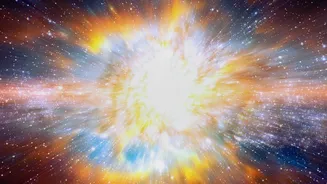
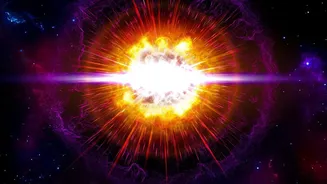
What Kepler and his contemporaries thought was the birth of a star was actually its spectacular death. Today, scientists have identified SN 1604 as a Type Ia supernova. This type of explosion typically happens in a binary star system, where two stars orbit each other. One of the stars is a white dwarf—the small, dense remnant of a star like our Sun. The white dwarf's powerful gravity pulls material from its larger companion star. When the white dwarf accumulates too much mass, it triggers a runaway thermonuclear explosion, obliterating the star and shining with the light of billions of suns.
The Legacy of Kepler's Star
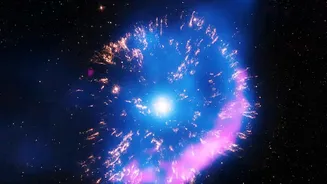
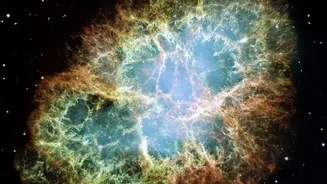
More than 400 years later, astronomers still study the aftermath of this explosion, now known as the Kepler Supernova Remnant. Using modern instruments like the Chandra X-ray Observatory, scientists can observe the expanding shell of superheated gas and debris blasting away from the explosion site at incredible speeds. The remnant is estimated to be about 20,000 light-years from Earth. Studying the historical light curve from records kept by Kepler and others, combined with modern analysis of the remnant, helps astronomers refine their models of Type Ia supernovae. These specific types of supernovae are crucial as they are used by scientists as 'standard candles' to measure cosmic distances and the expansion of the universe.