






India's Unblinking Eye on the Sun
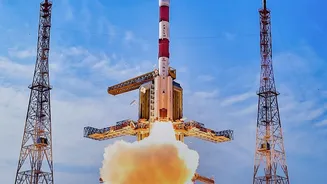
Following the historic success of Chandrayaan-3, the Indian Space Research Organisation (ISRO) launched its next ambitious venture: Aditya-L1. Named 'Aditya' after the Sanskrit word for the Sun, it is India’s first space-based observatory dedicated to studying
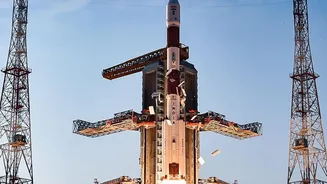
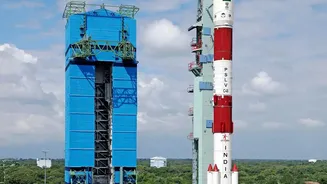
our solar system's star. Launched aboard a PSLV-XL rocket, the spacecraft embarked on a 1.5 million-kilometre journey from Earth. Its mission is not to land on the Sun, but to achieve something equally complex: to orbit a unique point in space that gives it a constant, uninterrupted view of solar activity. This strategic placement is key to its role as a premier solar research station, positioning India among a select group of nations capable of such advanced space science.
The Perfect Parking Spot in Space
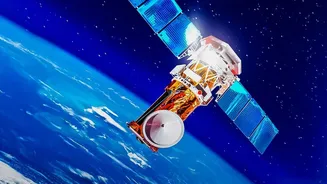
The destination for Aditya-L1 is the first Lagrange point, or L1. In the vast emptiness of space, Lagrange points are special locations where the gravitational pull of two large bodies—in this case, the Sun and Earth—balances out. An object placed here stays in a relatively stable position, almost like being parked in a cosmic sweet spot. This allows Aditya-L1 to orbit the Sun in sync with the Earth, requiring minimal fuel for orbit correction. More importantly, from this vantage point, the spacecraft has a continuous, clear view of the Sun, free from the eclipses or occultations that would occur in an Earth orbit. This 24/7 solar surveillance is precisely what's needed to monitor the Sun's ever-changing behaviour.
Decoding Dangerous Space Weather
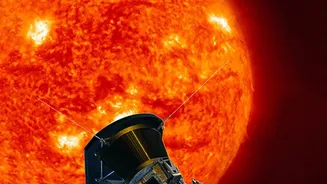
The primary driver behind the Aditya-L1 mission is the need to understand space weather. Just as weather on Earth affects our daily lives, weather in space, driven by the Sun, can have dramatic consequences. The Sun frequently unleashes massive bursts of energy and particles in the form of solar flares and Coronal Mass Ejections (CMEs). When these events are directed at Earth, they can be incredibly disruptive. They can damage satellites, knock out communication and GPS navigation systems, and even cripple terrestrial power grids by inducing powerful electrical currents. As our world becomes more dependent on technology, both in orbit and on the ground, the potential for a severe solar storm to cause widespread chaos increases. Aditya-L1 acts as an early warning system, studying these phenomena to help us better predict and mitigate their impacts.
A Toolkit for Solar Secrets
To achieve its goals, Aditya-L1 is equipped with seven sophisticated, indigenously developed payloads. Four of these are remote-sensing instruments that observe the Sun's photosphere, chromosphere, and its outermost layer, the corona. The Visible Emission Line Coronagraph (VELC), the primary payload, is designed to study the corona and the origin of CMEs. Other instruments like the Solar Ultraviolet Imaging Telescope (SUIT) will capture images of the Sun in different ultraviolet wavelengths. The remaining three payloads perform in-situ measurements, directly sampling the solar wind and magnetic fields as they pass the spacecraft. This combination of remote and direct observation will provide a comprehensive picture of solar events, from their origin on the Sun to their journey through space.
A Milestone for India and the World
Aditya-L1 is a landmark achievement that cements India’s status as a major player in space exploration. It demonstrates ISRO's capability to execute complex, deep-space missions that push the boundaries of science and technology. The data collected is already providing new insights into solar storms and their interaction with Earth's magnetic field. This research is not just for national pride; the findings are shared with the global scientific community, contributing to a worldwide effort to safeguard our technological infrastructure. By providing crucial data for space weather models, Aditya-L1 enhances our collective ability to prepare for the Sun's most powerful outbursts, making it a vital asset for our increasingly space-dependent civilization.