

The end of our solar system is an event billions of years away, but scientists are constantly refining the timeline. A new model suggests the long-predicted planetary chaos may kick off much sooner than we thought, even before the Sun's final act.
The Sun’s Long Goodbye
Our
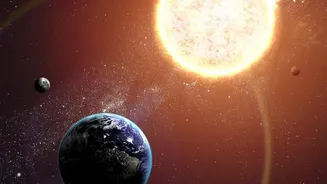
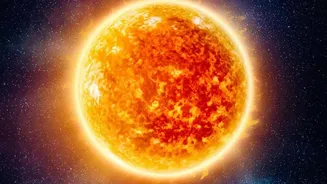
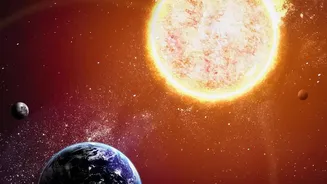
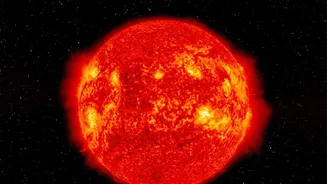
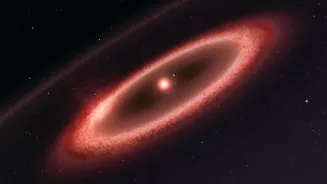
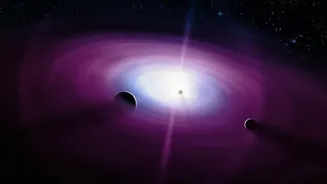
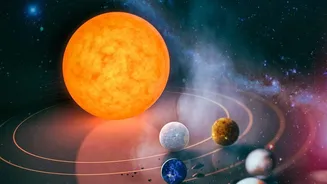
Sun, like all stars, has a finite lifespan. For the last 4.6 billion years, it has been in its stable main-sequence phase, fusing hydrogen into helium and providing the light and heat that make life on Earth possible. But in about five billion years, that hydrogen fuel will run out. This will trigger a dramatic transformation. The Sun's core will collapse, and its outer layers will swell enormously, turning it into a red giant. In this phase, it will become so large that it is expected to engulf the inner planets, Mercury and Venus. Earth's fate remains a topic of debate among scientists; it might be swallowed whole or left a scorched, lifeless rock. After this phase, the Sun will shed its outer layers and shrink into a dense, Earth-sized remnant called a white dwarf, which will slowly cool over trillions of years.
An Earlier Timeline for Chaos
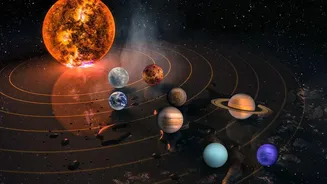
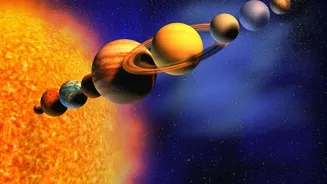
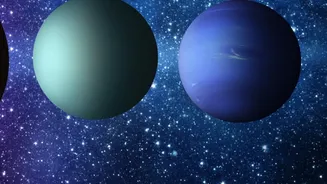
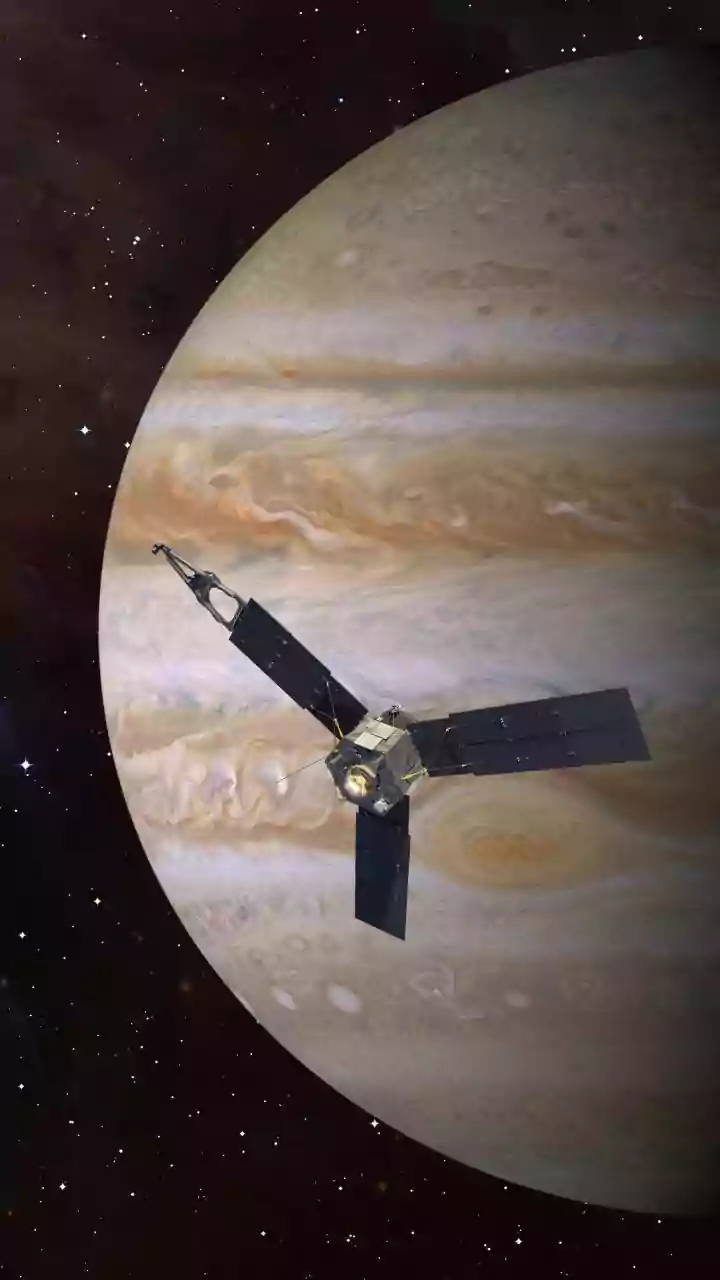
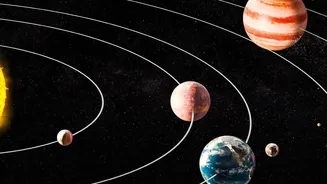
For a long time, astronomers believed the outer planets—Jupiter, Saturn, Uranus, and Neptune—would be relatively safe during this transition. Previous models suggested their orbits would expand as the Sun lost mass but remain stable for tens or even hundreds of billions of years afterward. However, a new study published in The Astrophysical Journal Letters proposes a much more violent and accelerated timeline. Researchers now suggest that the process of the Sun shedding its mass will be far from smooth. Instead of a gentle, consistent wind, the Sun will likely eject its mass in thousands of uneven, chaotic bursts. These random 'kicks' will nudge the Sun slightly with each eruption, altering its gravitational pull on the remaining planets.
How a Dying Star Shakes a System Apart
This new model introduces a powerful element of randomness into the end-of-life equation. Think of it like a spinning top that gets flicked repeatedly from different directions; its wobble becomes unpredictable. Similarly, as the dying Sun ejects massive blobs of its own material, each ejection gives the star a tiny push in the opposite direction. While each individual 'kick' is small, the cumulative effect of thousands of these over hundreds of thousands of years can significantly alter the delicate gravitational balance of the entire solar system. These gravitational shifts can be enough to nudge the giant planets out of their stable orbits, creating a kind of cosmic pinball machine.
A Violent Future for the Giant Planets
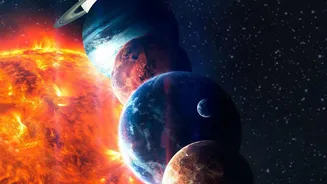
The computer simulations based on this new model paint a dramatic picture. According to the research, there is a significant chance that this instability will begin long before the Sun even becomes a white dwarf. In about 40% of the simulations, major disruptions began while the Sun was still in its giant-branch phase. The potential outcomes are extreme: planets could be flung into new, eccentric orbits that cross each other's paths, leading to cataclysmic collisions. Some simulations showed Saturn being ejected from the solar system entirely, while Uranus and Neptune were seen swapping places. This chaos means that the outer solar system, once thought to be stable for eons, could be dismantled within just a billion years of the Sun becoming a white dwarf—a timeframe a hundred times shorter than some previous estimates.