


Cosmic Archaeology: Why Chemicals Matter
When we look at the universe's first galaxies, we are performing a kind of cosmic archaeology. The Big Bang produced only the simplest elements: hydrogen, helium, and a tiny amount of lithium. Every other element, from the oxygen we breathe to the carbon
that forms the basis of life, was forged inside stars and scattered across space when they died. By mapping the chemical composition of early galaxies, astronomers can piece together a timeline of the universe's evolution. Finding heavier elements, which astronomers call 'metals', in a very distant galaxy means that at least one generation of stars has already lived, died, and seeded its environment with new material. This process of chemical enrichment is a crucial step in creating the complex universe we see today, and ultimately, the conditions necessary for planets and life to form.
Webb’s Chemical Toolkit: The Power of Spectroscopy
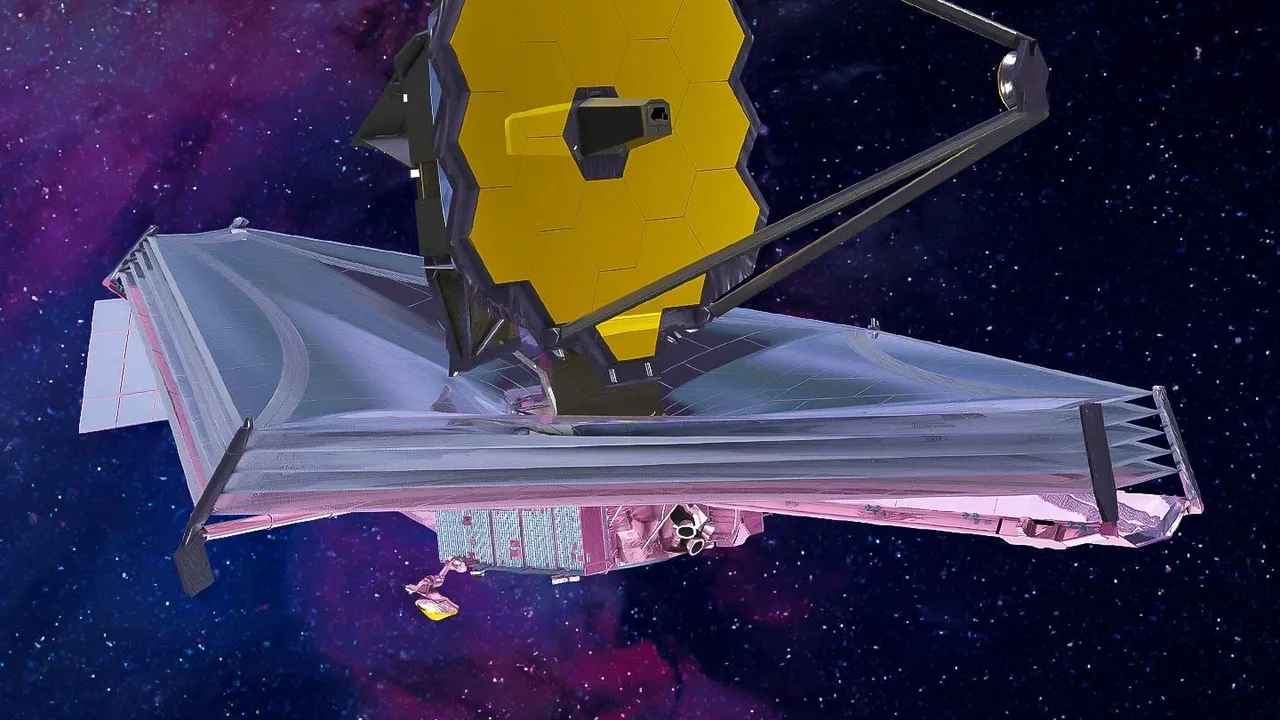
The magic behind this chemical mapping isn't a traditional camera, but a powerful technique called spectroscopy. The Webb telescope is equipped with a suite of highly sensitive spectrographs, primarily the Near-Infrared Spectrograph (NIRSpec) and the Mid-Infrared Instrument (MIRI). A spectrograph works like a very sophisticated prism, taking the faint light from a distant galaxy and splitting it into a rainbow of its component wavelengths. This rainbow, or spectrum, is not smooth. It's interrupted by a series of bright or dark lines, creating a unique pattern. Each chemical element and molecule absorbs and emits light at specific, characteristic wavelengths. This pattern acts as a unique 'fingerprint' or 'barcode' that allows scientists to identify precisely which elements are present in the galaxy, even from billions of light-years away.
Reading the Rainbows of Ancient Light
NIRSpec is a particularly revolutionary tool. For the first time in space, it allows astronomers to observe over 100 objects simultaneously. It uses a remarkable piece of technology called a micro-shutter array, a grid of nearly a quarter of a million tiny windows that can be opened or closed individually. This allows scientists to block out unwanted light and precisely select dozens of faint, early galaxies from a deep field image to analyze their spectra all at once, a process that would have taken ages with previous telescopes. By analyzing the 'fingerprints' in this data, scientists can measure not just the presence of elements like oxygen, carbon, and neon, but also their abundance. This tells a detailed story about a galaxy's age, its history of star formation, and its evolutionary stage.
Rewriting the First Cosmic Chapter
This powerful capability is already yielding surprising discoveries. Webb has found galaxies that are unexpectedly mature and chemically complex for their primordial era. For instance, the JADES program identified a galaxy called JADES-GS-z14-0, seen as it was less than 300 million years after the Big Bang, that already contained a surprising amount of oxygen. This suggests that star formation began even earlier than many models predicted. In other cases, Webb has detected complex organic molecules—compounds based on carbon—in galaxies more than 12 billion light-years away. These molecules, such as polycyclic aromatic hydrocarbons (PAHs) and even benzene, are essential building blocks for life as we know it, and finding them so early in cosmic history is a major breakthrough.