

The 'Earth 2.0' Fixation
For as long as we have gazed at the stars, we have wondered if we are alone. This question has driven the search for exoplanets, planets orbiting stars other than our sun. For decades, the guiding principle was to find 'Earth 2.0': a rocky planet, roughly
Earth-sized, orbiting within its star's 'habitable zone' — the 'Goldilocks' region where temperatures are just right for liquid water to exist on the surface. This focus makes sense; life as we know it depends on water, and our own planet is the only example we have of a successful biosphere. This led to excitement around discoveries of rocky worlds in the habitable zones of their stars, like Proxima Centauri b or the planets in the TRAPPIST-1 system.
A New Class of Contender: Hycean Worlds
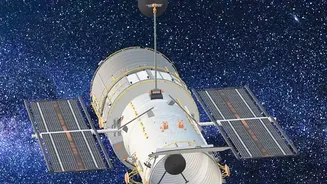
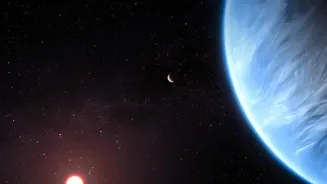
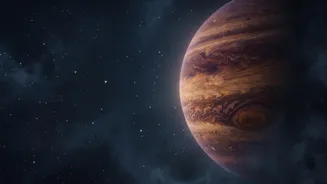
A new category of planet, first theorized in 2021 by researchers at the University of Cambridge, is dramatically expanding the search for life. Dubbed 'Hycean' worlds (a portmanteau of 'hydrogen' and 'ocean'), these planets are a far cry from Earth. They are typically larger, up to 2.6 times the size of our planet, and are defined by vast liquid water oceans underneath hydrogen-rich atmospheres. While their surface temperatures can be much higher than Earth's, researchers believe the conditions within their massive oceans could be similar to those that support microbial life in Earth's own deep-sea vents. These worlds are thought to be common, and because of their larger size and extended, less dense atmospheres, they are much easier to observe with telescopes like the James Webb Space Telescope (JWST). This makes them prime targets for atmospheric analysis.
Rethinking the Signs of Life
Expanding the types of habitable planets also means expanding our definition of a 'biosignature'—a sign of life. On Earth, the presence of abundant oxygen is a strong indicator of biological processes. But in a hydrogen-rich atmosphere like that of a Hycean world, oxygen would not be stable. Instead, scientists are now hunting for other molecules that could point to life. These include gases like dimethyl sulfide (DMS), which on Earth is produced almost exclusively by marine life, as well as methyl chloride and carbon disulphide. The detection of methane alongside carbon dioxide could also be a powerful biosignature, as their coexistence in certain environments isn't easily explained without a biological source constantly replenishing them.
The Weird and Wonderful Possibilities
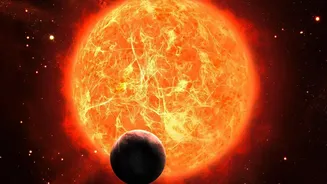
The universe is proving to be more creative than we once imagined. Beyond Hycean planets, scientists are considering other exotic possibilities. There are 'lava worlds,' rocky planets so hot their surfaces are molten, some of which have surprisingly been found to retain an atmosphere. While too hot for life, studying them helps us understand how rocky planets form and evolve. Some researchers have even theorized about 'superhabitable' planets—worlds that might offer conditions even better for life than Earth. These might be slightly older, larger, and warmer planets orbiting long-lived orange dwarf stars, giving complex life more time and stability to emerge. This shift in thinking encourages us not just to look for a second Earth, but for planets that might be even more suitable for life than our own.
A Broader Search, A Better Chance
By moving beyond the Earth-centric model, astronomers significantly increase the number of potential targets in the search for extraterrestrial life. Of the more than 6,000 exoplanets discovered so far, only a small fraction are considered Earth-like. By including worlds like Hycean planets, we cast a much wider net. Advanced tools like the JWST are already revolutionizing this field, allowing scientists to peer into the atmospheres of these distant worlds and hunt for the chemical fingerprints of life. While a confirmed discovery remains on the horizon, the exploration of these weird and wonderful worlds is already transforming our understanding of what it means for a planet to be 'habitable' and bringing us closer to answering one of humanity's oldest questions.