




The Sun's Unseen Temper
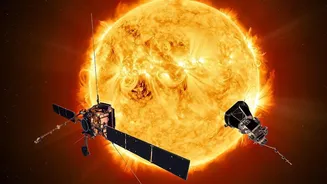
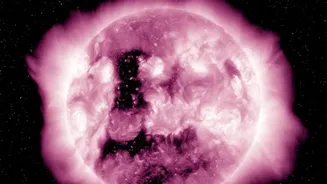
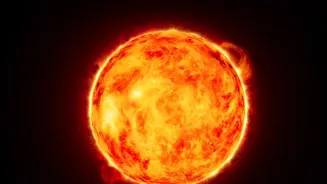
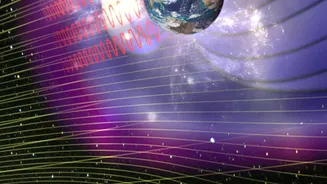
Space weather refers to the changing conditions in space driven by the sun's activity. Our star is not a quiet ball of fire; it's a dynamic and sometimes violent sphere of plasma. It regularly releases energy in several forms, including solar flares,
which are intense bursts of radiation, and coronal mass ejections (CMEs), which are massive clouds of charged particles and magnetic fields hurled into space. When these events are directed at Earth, they can interact with our planet's magnetic field and upper atmosphere, triggering geomagnetic storms that, while invisible, can have very tangible consequences on the ground and in orbit.
A High-Tech World at Risk
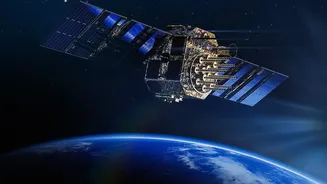
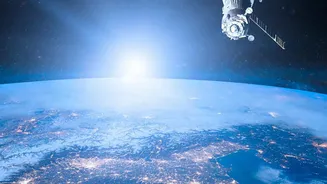
Our increasing reliance on technology makes us more vulnerable to space weather. Geomagnetic storms can induce powerful, uncontrolled currents in long conductors like power lines. These geomagnetically induced currents (GICs) can flow into electrical transformers, causing them to overheat, sustain damage, and potentially trigger large-scale blackouts. The economic impact of such outages can be immense, costing billions. In space, the risks are just as severe. Solar radiation can damage the sensitive electronics of satellites, disrupting everything from GPS navigation and telecommunications to weather forecasting. In some cases, increased atmospheric drag during a storm can even cause satellites to lose altitude. Airlines also monitor space weather to reroute flights away from polar regions during a storm to avoid communication blackouts and protect crew and passengers from elevated radiation levels.
The Global Sentry Network
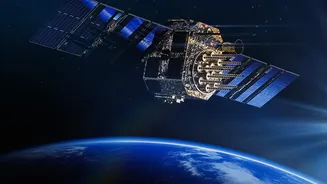
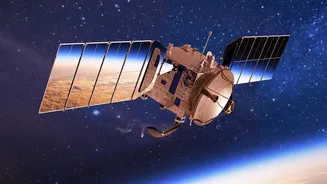
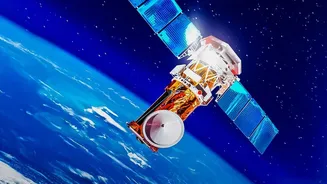
Like weather on Earth, space weather can be forecast. An international collaboration of agencies forms a planetary defence system, keeping a constant watch on the sun. A key player is the US-based Space Weather Prediction Center (SWPC), operated by NOAA, which serves as a global warning centre. It works alongside many international partners, including the European Space Agency (ESA) and space agencies in Australia, Japan, and Canada, to share data and improve forecasts. This network uses a combination of ground-based observatories and a fleet of specialized satellites. Spacecraft like the GOES and DSCOVR satellites monitor the sun for flares and measure the solar wind, the stream of particles constantly flowing from the sun. This gives forecasters a vital heads-up.
From Warning to Action
The goal of this tracking is to provide advance warning. A CME can take one to several days to travel from the sun to Earth, giving experts time to issue alerts. When a significant solar storm is forecast, satellite operators can take protective measures, such as temporarily powering down sensitive components or adjusting a satellite’s orbit to minimize damage. Similarly, power grid operators can adjust their systems to better withstand the impact of geomagnetically induced currents, preventing damage to critical transformers and avoiding blackouts. These early warnings are crucial for mitigating the worst effects and ensuring the resilience of the infrastructure that underpins our global economy and security.
India’s Eyes on the Sun
India has become a significant player in this global effort with the launch of its Aditya-L1 mission. Positioned 1.5 million kilometers from Earth at a special vantage point called Lagrange Point 1 (L1), the Indian Space Research Organisation (ISRO) observatory has an uninterrupted view of the sun. Aditya-L1 carries seven instruments to study the sun's outer layers and analyze the solar wind and magnetic fields in real-time. Its data provides crucial, early information on solar activities like CMEs, helping to understand the drivers of space weather and improve prediction models. By providing advance warning before a storm impacts Earth, Aditya-L1 is a vital new node in the international network safeguarding our critical space and ground-based assets.