

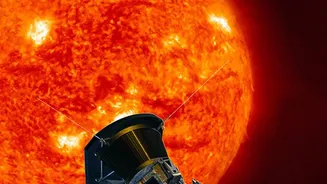
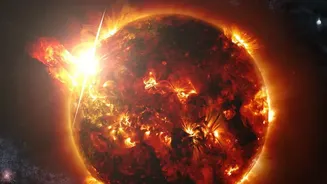
India's Aditya-L1 and Europe's Proba-3 missions are working in tandem, offering a revolutionary look at the Sun's violent eruptions and providing critical data that could redefine how we predict hazardous space weather.
A Landmark Collaboration in the Sky
In an unprecedented display of international
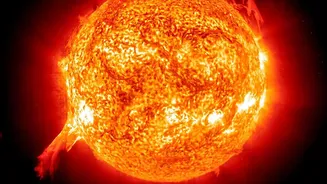
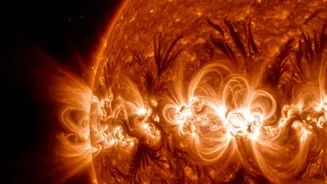
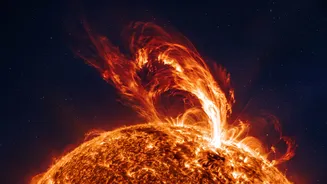
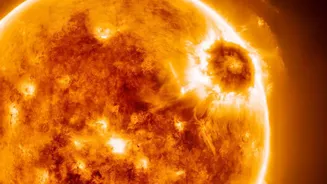
scientific synergy, India's flagship solar observatory, Aditya-L1, and the European Space Agency's (ESA) Proba-3 mission have begun to jointly unlock the secrets of the Sun's corona. By combining their unique observational capabilities, scientists are gaining deeper insights into the very first moments of coronal mass ejections (CMEs) — colossal eruptions of plasma and magnetic fields from the Sun. This partnership is not just about capturing stunning images; it's about fundamentally improving our ability to forecast space weather events that can have significant impacts on our technology-dependent world.
India's Unblinking Eye: Aditya-L1
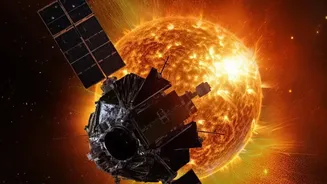
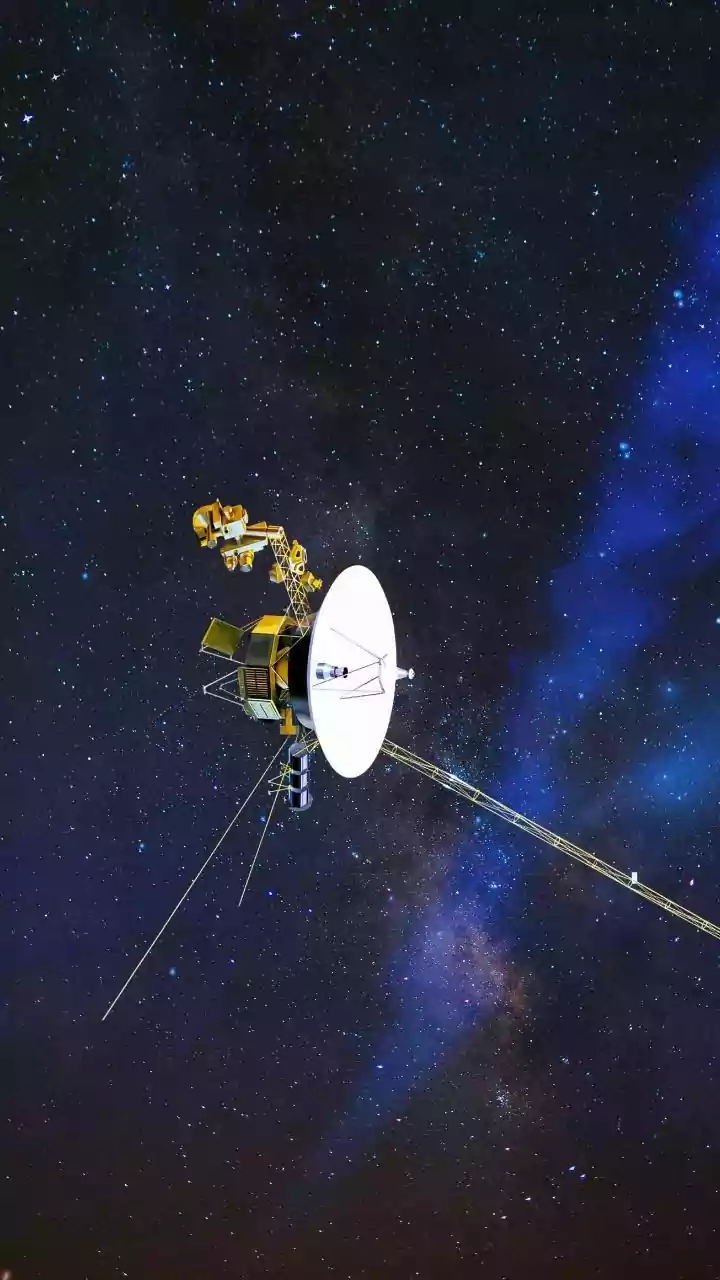
At the heart of this collaboration is Aditya-L1, India's first dedicated solar mission. Positioned at the strategic Lagrange point 1 (L1), about 1.5 million kilometres from Earth, the spacecraft has an uninterrupted view of the Sun. Its key instrument in this discovery is the Visible Emission Line Coronagraph (VELC), developed by the Indian Institute of Astrophysics. Unlike typical coronagraphs that only capture images, VELC performs spectroscopy, which allows it to analyse the properties of the light from the corona. This reveals crucial details about the temperature, speed, and density of the plasma as it begins to erupt, information that is invisible to a standard camera.
Europe's Artificial Eclipse: Proba-3
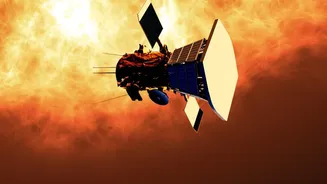
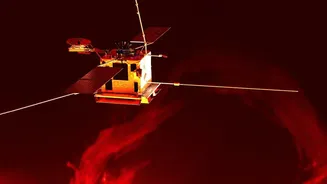
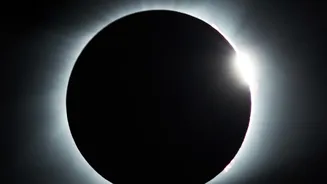
Complementing Aditya-L1's capabilities is ESA's Proba-3, the world's first precision formation-flying mission. Launched by an ISRO PSLV rocket in late 2024, Proba-3 consists of two satellites flying in a precise formation 150 metres apart. One spacecraft, the 'Occulter', blocks the bright face of the Sun, allowing the second spacecraft, the 'Coronagraph', to take incredibly clear and detailed images of the faint, inner corona — a region notoriously difficult to observe. This 'artificial eclipse' in space provides sharp, high-resolution images that reveal the shape, structure, and movement of a CME as it forms.
Seeing CMEs in a New Light
The latest findings stem from combining VELC's spectroscopic data with Proba_3's crisp imaging. Recently, scientists from the Indian Institute of Astrophysics used Aditya_L1 data to show that CMEs do not expand uniformly like a symmetrical bubble, a long_held assumption. Instead, they expand asymmetrically, with an uneven shape. This discovery is vital because the shape and structure of a CME influence how it travels through space, how much drag it experiences from the solar wind, and ultimately, its speed and arrival time at Earth. The complementary nature of the two missions allows scientists to cross_check their data, pairing VELC's detailed plasma measurements with ASPIICS's (Proba_3's coronagraph) structural images to build a more complete, three_dimensional picture of these solar storms right from their birth.
Why Early Warnings Matter
Coronal mass ejections are the primary cause of severe space weather. When a CME strikes Earth's magnetosphere, it can trigger geomagnetic storms. These storms can be beautiful, creating spectacular auroras, but they also pose a significant threat. They can damage satellites, disrupt GPS navigation and communication systems, and even induce powerful electrical currents in ground_based power grids, potentially causing widespread blackouts. The Carrington Event of 1859, the most powerful geomagnetic storm on record, caused telegraph systems to fail and even set some offices on fire. In our modern, interconnected world, the impact would be far more catastrophic. Earlier and more accurate warnings give satellite operators and power grid managers crucial time to take protective measures.
The Future of Space Weather Forecasting
The synergy between Aditya–L1 and Proba–3 represents a major leap forward in heliophysics. For the first time, scientists are able to combine spectroscopic and high–resolution imaging data to study the initial phase of CMEs. This is helping to validate and improve the complex models used to predict the trajectory and intensity of solar eruptions. By understanding the early, asymmetric expansion of CMEs, forecasters can make more accurate predictions about their potential impact on Earth. This partnership is turning space weather forecasting from a reactive science into a predictive one, providing an essential shield for our increasingly space–reliant civilization.