







The Growing Threat on the East Coast
India’s eastern coast has always been vulnerable to cyclones, but the situation is becoming more dire. Climate change is contributing to more intense storms and higher storm surges, which can flood vast areas, contaminate agricultural land with salt,
and endanger millions of lives. Studies show that by 2050, as many as 36 million Indians could be at risk of chronic flooding. Villages in states like Odisha, Andhra Pradesh, and West Bengal have witnessed firsthand the devastation caused by cyclones, where tidal waves have washed away homes, fields, and livelihoods. This escalating risk has created an urgent need for effective and sustainable coastal defense, moving beyond traditional concrete embankments which can sometimes trap floodwaters and worsen crop damage.
Nature's Resilient Barrier
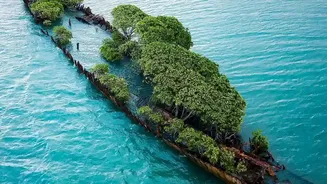
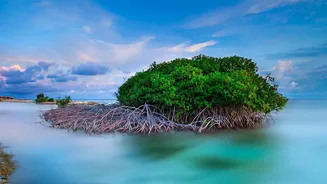
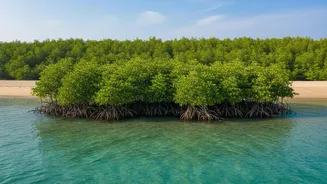
Enter the mangrove, a unique tree that thrives in the brackish water where land meets sea. These forests are far more than just coastal greenery; they are nature’s own bio-shields. Their complex, tangled root systems act like a natural wall, absorbing and dissipating the energy of waves. Research indicates that just 100 metres of mangrove forest can reduce wave energy by up to 66%. During a super cyclone in Odisha in 1999, villages sheltered by wider mangrove belts experienced significantly fewer deaths than those with little or no forest cover. These roots also trap sediment, helping to stabilize the shoreline and even build up the land over time, providing a dynamic defense against rising sea levels.
Community-Led Restoration in Action
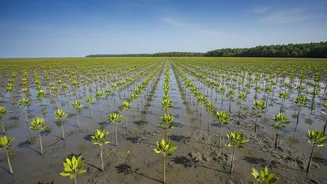
Across the eastern seaboard, a powerful movement is taking root. Local communities, often led by women, are at the forefront of restoring these vital ecosystems. In coastal villages in Odisha’s Balasore and Kendrapara districts, residents are planting thousands of mangrove saplings in degraded mudflats. These initiatives, often supported by government programs like the Enhancing Climate Resilience of India's Coastal Communities (ECRICC) project and NGOs, combine scientific assessment with invaluable local knowledge. Villagers help identify suitable plantation sites, raise saplings in nurseries, and undertake the crucial work of planting and monitoring. Their involvement ensures that the restoration is tailored to local conditions and fosters a sense of ownership, which is critical for long-term success.
From Protection to Prosperity
The benefits of mangrove restoration extend far beyond storm protection. These revitalized forests are becoming hubs of biodiversity and economic opportunity. They serve as critical breeding grounds for fish, crabs, and shrimp, boosting the catches of local fishing communities. This is particularly important in areas like Odisha, where long fishing bans are in place to protect turtle nesting sites. The return of healthy mangroves supports livelihoods through sustainable activities like apiculture (honey collection) and provides fodder for livestock. Furthermore, these projects create direct employment, with many initiatives providing hundreds of workdays for local people, especially women, who are involved in everything from nursery management to patrolling the young forests.
A Blueprint for the Future
The efforts in places like Andhra Pradesh, which has become a leader in mangrove restoration, and the Sundarbans in West Bengal, showcase a scalable model for climate adaptation. By blending government support, scientific expertise, and community action, these projects are creating resilient coastlines and tangible incomes. The innovative 'fish-bone' technique, used to restore natural tidal flows in degraded areas, has significantly improved sapling survival rates in Andhra Pradesh. These successes demonstrate that investing in nature-based solutions is not just an environmental imperative but a smart economic strategy. According to the UN, investments in mangroves can generate benefits four times greater than the costs.