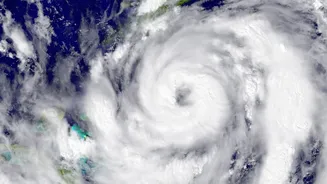







Cyclone Arnab, a 'Very Severe Cyclonic Storm', made landfall along the Andhra Pradesh coast early on October 28. It has prompted a large-scale evacuation in coastal Andhra Pradesh and Odisha. Here is what you need to know to stay safe.
Cyclone Arnab's Current Status
The India Meteorological
Department (IMD) confirmed that Cyclone Arnab completed its landfall process between 2 a.m. and 8 a.m. on Wednesday, October 28. It crossed the coast between Bapatla and Visakhapatnam as a 'Very Severe Cyclonic Storm' with maximum sustained wind speeds of 125-135 kmph, gusting up to 150 kmph. After making landfall, the system has weakened into a 'Severe Cyclonic Storm' and is expected to move north-northwestwards, gradually weakening further into a deep depression over the next 48 hours. Heavy rainfall continues to lash the region.
Areas on High Alert
Andhra Pradesh and Odisha are the two states most affected. In Andhra Pradesh, districts such as Kakinada, Konaseema, Anakapalli, and Visakhapatnam have experienced extremely heavy rainfall and strong winds. In Odisha, the southern districts of Malkangiri, Koraput, Rayagada, Gajapati, and Ganjam are on high alert for torrential rain and potential flooding. The IMD has issued a red alert for these southern Odisha districts and warned of a moderate to high risk of flash floods across vulnerable areas of both states, as well as parts of Telangana and Chhattisgarh.
Mass Evacuations Underway
State authorities have undertaken massive evacuation efforts to ensure zero casualties. More than 180,000 people have been moved from low-lying coastal areas to safer locations in Andhra Pradesh and Odisha. In Andhra Pradesh, over 89,000 people have been shifted to more than 2,000 cyclone shelters. The Odisha government has evacuated over 30,000 people, with a focus on districts like Malkangiri, which is expected to bear the brunt of the cyclone's impact as it moves inland. Special attention has been given to vulnerable populations, including thousands of pregnant women who were moved to hospitals as a precaution.
Official Government Advisories
Authorities are urging residents to stay indoors and follow all safety protocols. Fishermen have been strictly warned not to venture into the sea. In preparation, National Disaster Response Force (NDRF) and State Disaster Response Force (SDRF) teams have been deployed across the affected states. At least 31 NDRF teams are on the ground in Andhra Pradesh, Odisha, Telangana, and Chhattisgarh to assist with rescue and relief operations. To prevent accidents, power infrastructure has been proactively shut down in some areas, and residents are warned about the danger of live wires, with two deaths due to electrocution already reported in Andhra Pradesh.
Travel and Infrastructure Disrupted
The cyclone has caused significant disruption to travel and public services. Dozens of train services have been cancelled or rescheduled by Indian Railways as a precautionary measure. Flights to and from Visakhapatnam, Vijayawada, and Rajahmundry airports were suspended ahead of the cyclone's landfall. Widespread power outages have been reported after thousands of electricity poles were uprooted by strong winds. Uprooted trees have blocked roads in several districts, and response teams are working to clear the obstructions. Schools and colleges in several districts of Andhra Pradesh and Odisha have been ordered to remain closed.