




India’s Most Ambitious Lunar Quest
Chandrayaan-4 represents a monumental leap in India's space exploration journey. Its primary goal is to execute a lunar sample-return mission, something only three other countries have ever accomplished. The plan involves landing a robotic craft near
the Moon's south pole, collecting several kilograms of lunar regolith (soil) and subsurface material, and returning it safely to Earth for scientific analysis. Approved by the Union Cabinet in September 2024, this mission is not just an incremental step but a demonstration of end-to-end deep space capability, involving technologies ISRO has never before attempted on a single mission. It is a crucial stepping stone toward India’s long-term vision of sending astronauts to the Moon by 2040.
Why Sample Return is the Next Frontier
While rovers and landers can perform incredible science on-site, their instruments are limited by size, weight, and power. Bringing lunar samples back to Earth allows scientists to use the full power of terrestrial laboratories, employing massive, highly sensitive equipment that could never be launched into space. These pristine samples can be studied for decades, answering new questions with future technology. The chosen landing site in the south polar region is particularly tantalizing. This area is believed to contain water ice in permanently shadowed craters. Analyzing this ice and surrounding soil could unlock secrets about the origin of water on the Moon and Earth, and provide critical information for establishing a future sustained human presence.
An Intricate Five-Module Dance
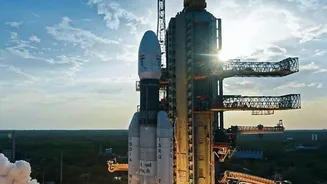
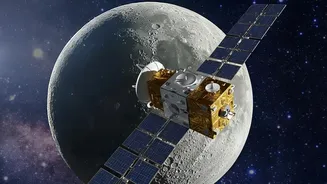
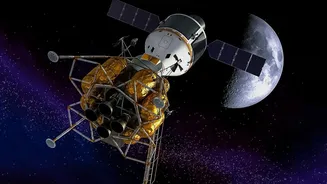
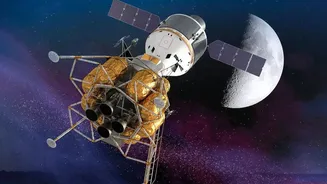
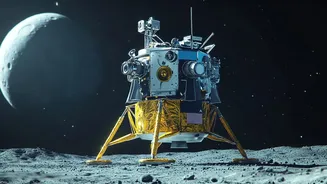
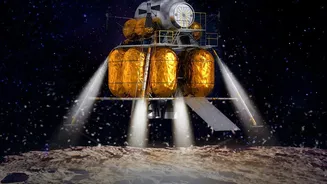
The complexity of Chandrayaan-4 is reflected in its architecture, which is made up of five distinct modules: a Propulsion Module (PM), Descender Module (DM), Ascender Module (AM), Transfer Module (TM), and a Re-entry Module (RM). The total weight, around 9,200 kg, is too heavy for ISRO’s most powerful rocket, the LVM3, to carry in one trip. The ingenious solution is to launch the mission in two parts. Two LVM3 rockets will carry the modules into Earth orbit as separate stacks. There, they will perform India’s first-ever orbital docking to assemble into the final, integrated spacecraft before the journey to the Moon begins.
The Journey: A Multi-Stage Challenge
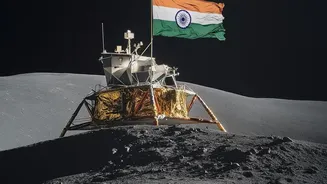
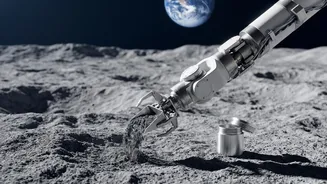
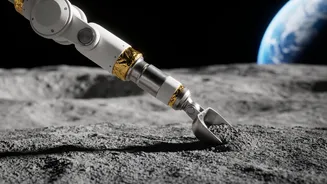
The mission unfolds in a series of high-stakes manoeuvres. After arriving in lunar orbit, the Descender and Ascender modules will separate and perform a soft landing. Once on the surface, a robotic arm will scoop up soil and a drill will collect subsurface material, loading the precious cargo into the Ascender module. Then comes another critical first: the Ascender will launch off the Moon, using the Descender as a launchpad, to rendezvous and dock with the Transfer and Re-entry modules waiting in orbit. After the samples are robotically transferred to the Re-entry capsule for the trip home, the Transfer Module will fire its engines to push the capsule back towards Earth. The final step involves the Re-entry Module surviving a fiery plunge through our atmosphere to deliver its cargo to scientists.
The Road to a 2028 Launch
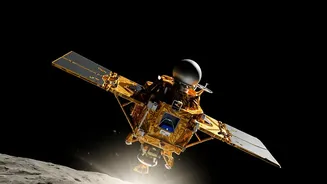
While the initial government approval in 2024 outlined a 36-month timeline, the immense technical challenges of developing and validating so many new systems have led to a revised target launch date of around 2028. ISRO has already been methodically testing the required technologies. A key milestone was the success of the SPADEX (Space Docking Experiment) mission, which proved the autonomous docking capability essential for the mission's two-launch strategy. This careful, step-by-step approach underscores the mission’s complexity and ISRO's commitment to getting it right. The mission is distinct from LUPEX, a separate joint Indo-Japanese mission also targeting the lunar pole, which will focus on deploying a heavy rover designed to survive the lunar night.