




A Galaxy of Beautiful Contradictions
To the casual observer with a good telescope, Centaurus A looks like a bright elliptical galaxy sliced in half by a thick, dark band of dust. This striking feature is the remnant of a galactic collision that occurred roughly two billion years ago, when
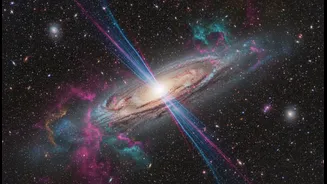
a large elliptical galaxy devoured a smaller spiral one. The aftermath left a chaotic, warped disc of gas and dust that continues to shape the galaxy's evolution. At its heart lies an active supermassive black hole, furiously consuming material and blasting out enormous jets of energy that extend far into space. This combination of a violent history and an active core makes Centaurus A a perfect natural laboratory for understanding how galaxies evolve, how black holes influence their surroundings, and how new stars are born from cosmic wreckage.
Seeing Through the Dust with Webb
For decades, that prominent dust lane has acted like a curtain, hiding the galaxy’s core from telescopes that see in visible light, like Hubble. While infrared telescopes like Spitzer could sense the larger structures, they lacked the sharpness to see fine details. This all changed with the James Webb Space Telescope (JWST). Celebrating its fourth year of operations, new images from Webb have pierced through the dust, offering an unprecedentedly clear view. What previously looked like a grainy glow is now resolved into millions of individual stars. This allows astronomers to perform a kind of galactic archaeology, studying different generations of stars to reconstruct a timeline of the galaxy’s history—from before the great merger to the bursts of star formation it triggered.
New Mysteries and Perplexing Shapes
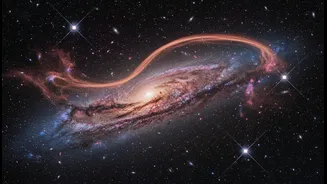
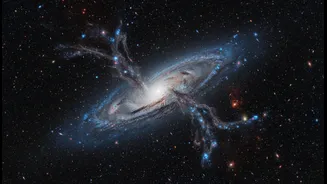
Webb’s mid-infrared vision has revealed intricate filaments and glowing clouds of warm dust that have surprised and even perplexed astronomers. The images show a strange, parallelogram-like band cutting across the galaxy’s centre and a mysterious “S” shaped feature nearby. Scientists are now working to determine what created these unusual structures. Are they lingering scars from the ancient collision, products of ongoing star formation, or shapes sculpted by the powerful influence of the central black hole? The glowing red points scattered across Webb's new images highlight stellar nurseries, where new stars are forming from the very dust left behind by the collision, providing the raw material for future generations of stars and planets.
Zooming in on the Central Engine
While Webb excels at revealing stars and dust, another global collaboration is focused on the black hole itself. The Event Horizon Telescope (EHT), the same network of radio dishes that captured the first-ever image of a black hole in the M87 galaxy, has turned its gaze to Centaurus A. Its observations have pinpointed the location of the supermassive black hole at the very base of one of its gigantic jets. The new, high-resolution images show that the jet is brighter along its edges, a striking feature that challenges some theoretical models of how black hole jets work and helps scientists refine their understanding of these powerful phenomena. The ultimate goal for the EHT is to one day photograph the shadow of Centaurus A's black hole directly, which may require adding space-based telescopes to the array for even greater sharpness.
The Dual Role of a Black Hole
The latest observations are giving us a more complex picture of the relationship between a supermassive black hole and its host galaxy. Webb's data allows scientists to measure the motion of gas swirling near Centaurus A's core. They can see how the black hole's immense energy blasts material outwards, which can inhibit star formation by clearing away the necessary gas. At the same time, the pressure from these jets can also compress gas in other regions, triggering the birth of new stars. It’s a dynamic interplay of creation and destruction. Centaurus A, being so close and active, offers a ringside seat to witness this fundamental cosmic process, helping us understand the delicate balance that governs the life and death of stars across the universe.