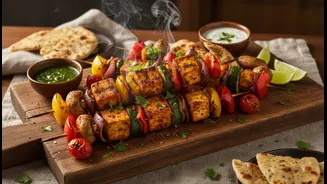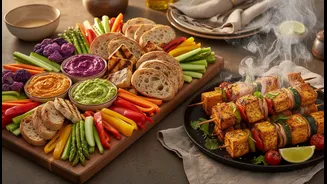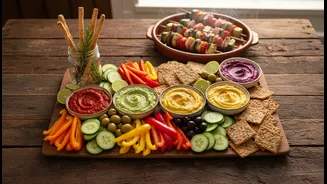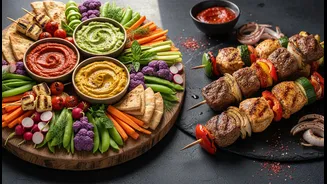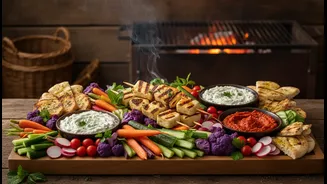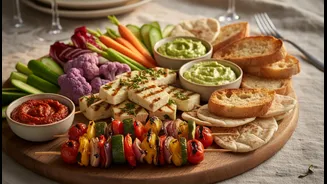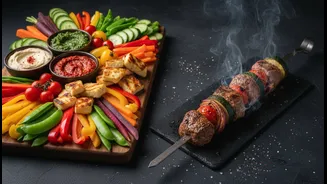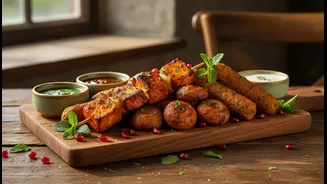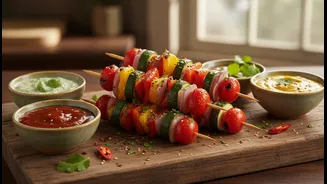




The Modern Kebab Platter
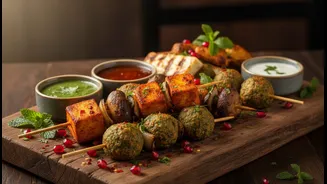
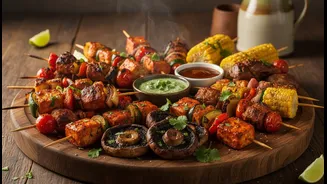
Walk into any trendy gathering today, and you're likely to find a meticulously arranged platter laden with colourful, bite-sized delights. The star of this spread is increasingly the vegetarian kebab. From soft Dahi ke Kebab to hearty Hara Bhara Kebab,
these plant-based versions are shedding their reputation as a mere afterthought. This shift is not just about catering to vegetarianism; it's about a broader appreciation for texture, flavour, and culinary creativity. No longer limited to the classic paneer tikka, chefs and home cooks are exploring an arsenal of ingredients like jackfruit, lotus stem, yam, and various lentils to create kebabs that are delicious in their own right. This modern snack board, with its array of meatless marvels, invites us to look closer at what a kebab truly is.
Beyond Meat and Skewers
The history of the kebab in India is a rich tapestry woven with threads of migration, royalty, and regional innovation. While many associate kebabs with the Mughals, who certainly refined them into an art form, the practice of grilling meat over an open fire is ancient. Legend speaks of soldiers grilling meat on their swords, the earliest and most rugged form of the kebab. But as the dish settled in the royal kitchens of Awadh, Hyderabad, and beyond, it evolved. It became less about the piece of meat and more about the technique: the art of the marinade, the mastery of temperature, and the alchemy of spices. The famous Galouti kebab, for instance, was created for a toothless Nawab, proving that the ultimate goal was a melt-in-the-mouth texture, a principle that can be applied to vegetables just as effectively as to meat.
The Secret of the Smoke
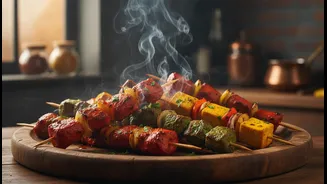
One of the most defining characteristics of a truly memorable kebab is a subtle, smoky aroma that perfumes every bite. This isn't always achieved by cooking over a live fire. A traditional technique called 'Dhungar' is often the secret weapon. This method involves placing the cooked dish in a pot, putting a small heatproof bowl in the center, and adding a piece of red-hot charcoal to the bowl. A spoonful of ghee is then drizzled over the charcoal, which immediately releases a thick, aromatic smoke. The pot is quickly covered, trapping the smoke and allowing it to infuse the food for a few minutes. This technique is a game-changer, lending an authentic, tandoor-like flavour to everything from dal makhani to, yes, a platter of vegetarian kebabs, proving that the smoky essence is a matter of craft, not just cooking method.
A Journey Through Regional Gems
The vegetarian snack board encourages us to explore the vast landscape of regional kebabs. In Lucknow, the tradition of soft, delicate patties continues with vegetarian versions of the Galouti, often made with rajma or yam. From Hyderabad, we get the Shikampuri kebab, a stuffed patty that has a delightful vegetarian counterpart. The popular Hara Bhara Kebab, a staple from North India, is a celebration of greens like spinach and peas. Even the Seekh Kebab, traditionally made with minced meat pressed onto a skewer, has been brilliantly reimagined using minced vegetables, soya, or raw banana. Each regional variation tells a story of local ingredients and culinary ingenuity, a story that is now being retold through a vegetarian lens.