







The Tall Tree Misconception
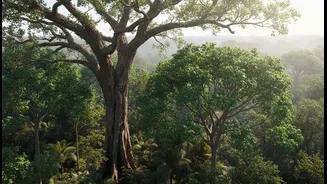
For a long time, a simple idea has guided how we think about forest vulnerability: taller trees are at greater risk. The logic seems sound. A taller tree has to transport water over a much longer distance, fighting gravity every inch of the way. This
makes it, in theory, more susceptible to drying out during a drought. They are also more exposed to high winds, lightning, and other physical stressors. Based on this, many models predicting the impact of climate change assumed that forests with towering canopies would be the first to suffer. Ecologists and forest managers often used height as a straightforward proxy for vulnerability. However, a growing body of research is showing that this is an oversimplification and that the real story of resilience is written not in a tree's height, but in its fundamental biology.
A Shift in Focus to Traits
Scientists now argue that focusing on a tree's 'functional traits' provides a much more accurate picture of its ability to withstand challenges like drought. These traits are the specific anatomical and physiological characteristics that govern a plant's growth, survival, and reproduction. Think of it like a car: knowing its height doesn't tell you much about its performance. You need to know what's under the hood—the engine type, the fuel efficiency, the quality of the tires. For trees, these 'under the hood' features are what truly determine whether they can survive when conditions get tough. Recent studies have found that some of the world's tallest trees have developed remarkable adaptations to move water efficiently, challenging the old assumption that height automatically equals weakness. This trait-based approach scales up from individual species to predict how whole ecosystems will respond to environmental change.
The Traits That Truly Matter
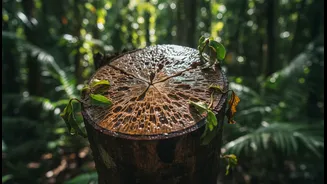
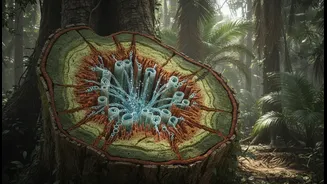
So, what are these critical traits? One of the most important is wood density. Denser wood is generally more resistant to the internal collapse of water-transporting vessels (xylem) during severe drought. Another key trait is a tree’s hydraulic strategy—how it manages water. Some species are 'conservative', shutting down their pores (stomata) early in a drought to conserve water, while others are 'risk-takers', continuing to photosynthesise but risking hydraulic failure. Other vital characteristics include leaf size and shape, which affect water loss, and root depth, which determines access to deeper water sources. By analysing these traits, ecologists can build a more nuanced and predictive model of forest resilience. A forest full of tall trees with dense wood and deep roots might be far safer than a shorter forest of species with 'live fast, die young' strategies.
A New Playbook for Indian Forests
This new understanding has profound implications for forest management, particularly in a country like India with its vast and diverse forest ecosystems. As climate change brings more frequent and intense droughts, heatwaves, and erratic monsoons, protecting these vital resources is a national priority. By moving beyond simple height measurements, forest managers can make more informed decisions. For instance, in reforestation projects, a trait-based approach can help select a mix of native species best suited to future conditions, rather than just planting the fastest-growing or tallest ones. It allows for the creation of 'climate-ready' forests that are more resilient and can continue to provide essential services like clean water, carbon storage, and biodiversity protection. It also helps in identifying which existing forests are most at risk, allowing for targeted conservation efforts before a crisis hits.