


The Hum of the Cosmos
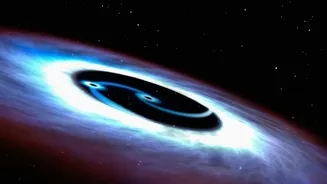
Imagine spacetime as a vast, stretched fabric. When massive objects like black holes collide, they create ripples in this fabric, much like a boat creates a wake in water. These ripples are gravitational waves, and they travel across the universe carrying
information about their cataclysmic origins. For years, observatories like LIGO and Virgo have detected high-frequency waves from the merger of smaller, stellar-mass black holes. But a different kind of signal has recently emerged. Collaborations like the North American Nanohertz Observatory for Gravitational Waves (NANOGrav) use pulsars—ultradense, spinning stars that act like cosmic clocks—to listen for much slower, low-frequency gravitational waves. They have recently confirmed a persistent background hum of these waves, a discovery that opens a new window into the universe's most massive events.
The Galaxy's Missing Middle Child
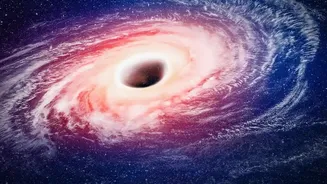
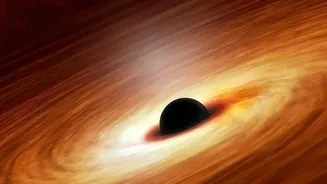
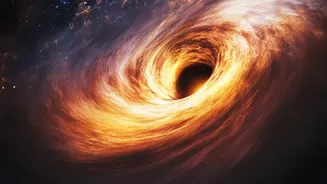
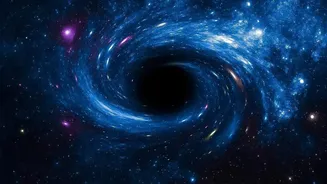
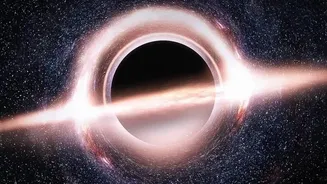
Astronomers have long known about two main types of black holes: small, 'stellar-mass' ones (a few to 100 times the mass of our sun) formed from collapsed stars, and 'supermassive' ones (millions to billions of times the sun's mass) that sit at the center of large galaxies like our own Milky Way. But what about the ones in between? The existence of Intermediate-Mass Black Holes (IMBHs) has been a long-standing puzzle. These objects, with masses between a hundred and a hundred thousand suns, are considered the 'missing link'. Theory suggests they must exist, potentially as the seeds that grow into the supermassive giants, but finding direct evidence has been incredibly difficult. They are crucial to understanding how galaxies form and evolve, yet they have remained stubbornly hidden.
A New Chorus of Evidence
The persistent, low-frequency hum detected by pulsar timing arrays is believed to be the combined chorus of countless IMBHs and supermassive black holes merging across the cosmos. This gravitational wave background is the signature of these titanic collisions. While individual merger events from IMBHs are hard to isolate, their collective signal provides powerful evidence not only that they exist, but that they are common. These detections fill a crucial gap in our observations. While LIGO can see the final, violent moments of smaller black hole mergers, projects like NANOGrav and the upcoming space-based LISA mission can sense the slow, cosmic dance of much larger pairs of black holes orbiting each other for millions of years.
Architects of the Universe
So how do these IMBHs shape galaxies? The leading theory is that they are the original building blocks. Early in the universe, dense star clusters could have seen runaway collisions of massive stars, forming the first IMBHs. These IMBHs then acted as gravitational anchors, attracting gas, stars, and even other smaller black holes. As smaller galaxies merged to form larger ones—a process called hierarchical merging—their central IMBHs would eventually sink to the center of the new, larger galaxy and merge themselves. This process of repeated mergers, which we are now detecting through gravitational waves, is how supermassive black holes are thought to be built. In essence, the entire structure, size, and evolution of a galaxy are intricately linked to the growth of the monster black hole at its heart, a process that starts with these crucial intermediate seeds.
Listening for What Comes Next
This is just the dawn of a new era in astronomy. The confirmation of the gravitational wave background is a starting point. Scientists are now working to sift through the noise to find individual sources, creating a map of merging supermassive and intermediate-mass black holes across the sky. The latest catalogs from LIGO-Virgo-KAGRA are already showing evidence of 'second-generation' black holes formed from previous mergers, supporting the hierarchical merging theory. Future observatories, including more sensitive ground-based detectors and space missions like LISA, promise to provide even clearer signals, turning the background hum into a detailed symphony. Each new detection will offer more clues about how these cosmic architects construct their galactic masterpieces, bringing us closer to understanding our own origins.