





A Tale of Two Polygons
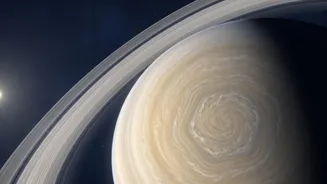
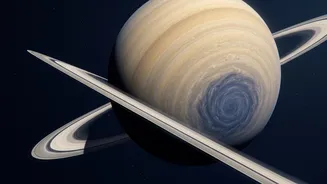
For decades, one of Saturn's greatest mysteries has been a massive, six-sided jet stream encircling its north pole. This feature, known as the hexagon, is a persistent storm system wider than Earth, first spotted by the Voyager spacecraft in the 1980s.
It has remained remarkably stable, a geometric marvel in a chaotic atmosphere. Scientists long wondered if it was a unique fluke. But in a recent twist, observations from the Hubble Space Telescope have confirmed a new, developing polygonal storm at Saturn's south pole—this one with ten sides. This 'decagon' appears to be a younger, more dynamic feature, first emerging in images around 2023. The discovery suggests such geometric storms might be a more common, though still bizarre, aspect of Saturn's weather.
How Do You Form a Storm with Corners?
How can a river of gas flowing at hundreds of kilometers per hour form a shape with sharp corners? The answer lies in the complex physics of fluid dynamics on a massive, rapidly spinning planet. Scientists believe these polygons are a type of 'standing wave' in the atmosphere. On Saturn, powerful jet streams flow at different speeds depending on their latitude. Where these currents meet and shear against each other, they can create turbulence and eddies. Under just the right conditions, these disturbances can organize themselves into a stable, repeating pattern that gets locked into a geometric shape around the pole. Laboratory experiments using rotating tanks of liquid have successfully recreated similar polygonal shapes, supporting the theory that these are naturally occurring phenomena given the right speeds and viscosity.
A Natural Laboratory for Giant Planets
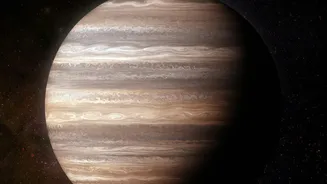
The existence of two different polygons on the same planet provides an unprecedented opportunity for comparative planetology. The north pole's hexagon is ancient and stable, while the south pole's decagon is new and seemingly still evolving. By studying why one pole formed a six-sided storm and the other a ten-sided one, researchers can test and refine their models of atmospheric dynamics. These models are crucial for understanding the weather on all gas giants, which share similar compositions of hydrogen and helium but exhibit vastly different conditions. For example, Jupiter is known for its multiple, swirling polar cyclones and the Great Red Spot, while Uranus has a surprisingly placid atmosphere, possibly due to its lack of internal heat. Saturn's polar polygons act as a bridge, helping scientists understand the underlying principles that create such diverse weather systems.
From Saturn to Jupiter and Beyond
The insights gained from Saturn's storms are already being applied to its giant neighbours. Scientists wonder if Jupiter's own clusters of cyclones, which arrange themselves into polygonal patterns at its poles, are related to the same phenomena seen on Saturn. The key difference could lie deep within the planets. Recent models suggest that the number and stability of polar vortices may depend on factors in the planet's interior, meaning the weather we see on the surface is a clue to the unseen structure thousands of kilometers below. By comparing the long-lived hexagon with the newly forming decagon, scientists can better understand the life cycle of these mega-storms. This knowledge will be invaluable for interpreting future observations of Uranus and Neptune, which also host their own immense storms like Neptune's famous 'Great Dark Spot'.