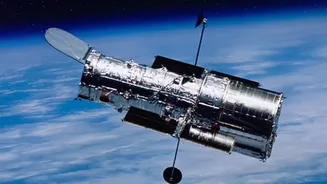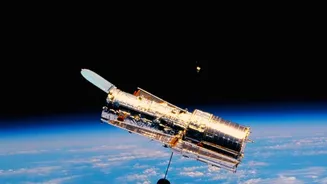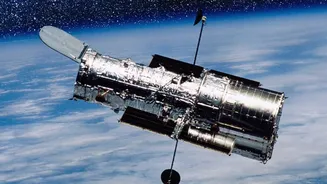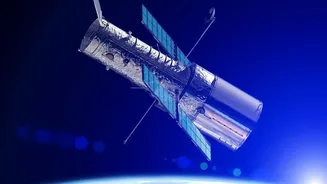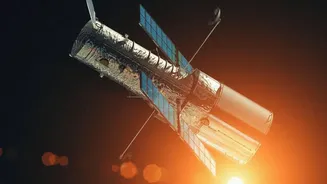





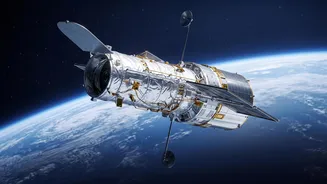

For over three decades, the Hubble Space Telescope has been humanity’s eye on the cosmos. Now, its orbit is slowly decaying, and in a landmark shift, NASA is turning to the commercial space industry to help write the next chapter for the legend.
A Legacy Written in the Stars
Since
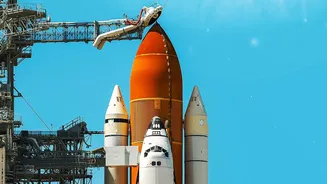
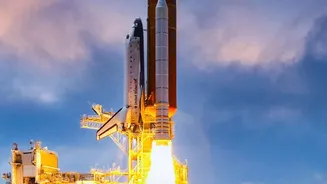
its launch in 1990, the Hubble Space Telescope has transformed our understanding of the universe. It has delivered breathtaking images of distant galaxies, helped pinpoint the age of the universe, and provided crucial evidence for the existence of dark energy. Its discoveries are woven into the fabric of modern astronomy, making it one of the most productive and significant scientific instruments ever built. Maintained over the years by five separate Space Shuttle servicing missions, the last of which was in 2009, Hubble has outlived all expectations. However, with the shuttle program retired, the telescope now faces a threat that new instruments can't fix: its orbit is shrinking.
The Inevitable Descent
Hubble orbits in the upper, extremely thin reaches of Earth's atmosphere. Even there, tiny amounts of atmospheric gas create drag, which gradually slows the telescope and causes its altitude to drop. Without any onboard propulsion to counteract this effect, its orbit has been slowly decaying for years. This process is accelerated by solar activity, which heats and expands the upper atmosphere, increasing drag. NASA's analysis predicts that without intervention, Hubble is likely to re-enter the atmosphere sometime between 2033 and 2034. Previously, Space Shuttle missions would periodically reboost it to a higher, more stable orbit, but that option is no longer available.
A New Call for Heroes
Recognizing the urgency, NASA has taken a novel approach. On October 29, 2026, the agency issued a formal Request for Information (RFI), asking the commercial space sector for ideas. This isn't a contract, but a market survey to see what's possible. The RFI outlines three main options: a mission to boost Hubble into a higher orbit of at least 600 kilometers, a servicing mission to potentially upgrade its systems, or a plan for a safe, controlled de-orbit. A successful boost could add another 15 to 25 years to Hubble's life. Companies have until November 30, 2026, to submit their concepts, which could involve either robotic or crewed missions.
The SpaceX and Polaris Precedent
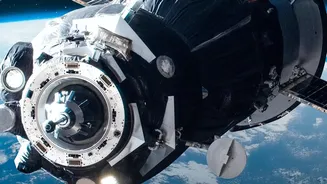
This formal request follows a 2022 proposal from the Polaris Program, a private human spaceflight initiative led and funded by billionaire Jared Isaacman. Working with SpaceX, the program initiated an unfunded study with NASA to explore the feasibility of using a SpaceX Dragon capsule to dock with Hubble and push it into a higher orbit. The study was meant to understand the technical challenges of such a mission, which would be the first of its kind for a commercial crew. While NASA did not proceed with that specific plan at the time, the proposal highlighted the growing capabilities of the private sector and likely paved the way for the current, broader solicitation. It demonstrated a tangible interest from commercial players in undertaking complex missions previously reserved for government agencies.
The Business of Saving an Icon
NASA's move signals a significant shift in the business of space. Instead of building a new, taxpayerfunded mission from scratch, the agency is looking to buy a service from a commercial provider. This opens the door for companies like SpaceX, Rocket Lab, and others specializing in satellite servicing to demonstrate their capabilities on a highprofile stage. A successful mission would not only save a priceless scientific asset but would also establish a new market for inorbit servicing. It could prove that valuable spacecraft can have their lives extended commercially, creating a business model for maintaining other critical assets in orbit, from weather satellites to future space observatories. The chosen company would be responsible for the launch, the spacecraft, and all mission operations.