

Seeing the Universe in a New Light
To understand why infrared is so crucial, you first have to know what it is. Think of the visible light spectrum as just one sliver of the information the universe is sending us. Beyond the red light our eyes can see lies infrared radiation, which we
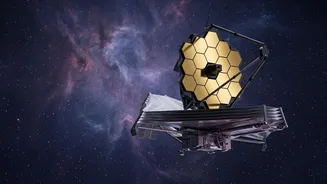
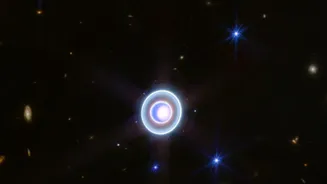
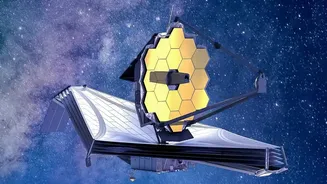
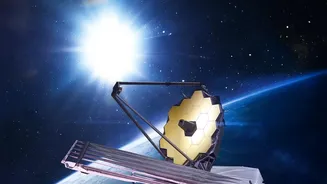
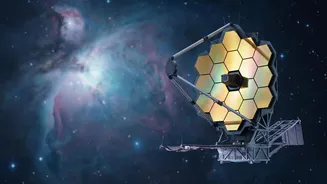
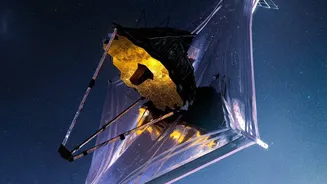
often perceive as heat. The James Webb Space Telescope is specifically designed to be incredibly sensitive to this invisible light, capturing wavelengths from the visible red all the way into the mid-infrared. This isn't just a niche capability; it's a fundamental design choice that unlocks a universe hidden from other telescopes. Because Earth's atmosphere blocks most infrared light, a space-based observatory like Webb is essential to view the cosmos in this way.
Piercing the Cosmic Veil
One of the biggest challenges in astronomy is that the universe is a dusty place. Vast clouds of interstellar gas and dust, where new stars and planets are born, can act like a thick fog, obscuring what lies within when viewed in visible light. However, longer-wavelength infrared light can penetrate these dusty veils much more effectively. This allows JWST to peer into stellar nurseries and see nascent planetary systems forming. More importantly for finding other worlds, it enables the telescope to get a clearer view of exoplanets that might otherwise be hidden.
The Barcode of an Alien Atmosphere
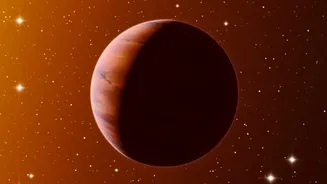
Here's where infrared vision becomes a superpower for studying foreign worlds. JWST uses a technique called transmission spectroscopy. When an exoplanet passes in front of its host star from our perspective, a tiny fraction of the starlight filters through the planet's atmosphere. Different molecules in that atmosphere—like water vapor, carbon dioxide, or methane—absorb very specific wavelengths of light. By analysing the starlight with JWST's spectrographs, scientists can see which wavelengths are missing. This creates a unique absorption spectrum, like a chemical barcode, that reveals exactly what the atmosphere is made of.
Hunting for the Building Blocks of Life
Many of the molecules that are key indicators of a planet's potential for life, known as biosignatures, have their strongest and clearest 'barcodes' in the infrared part of the spectrum. Webb's powerful instruments, like the Near-Infrared Spectrograph (NIRSpec) and the Mid-Infrared Instrument (MIRI), are tuned to detect these tell-tale signs. Webb's observations have already provided clear evidence of water vapor, sulfur dioxide, and carbon dioxide in the atmospheres of distant planets. The ultimate goal is to find a cocktail of chemicals that hints at a habitable environment, or even at life itself. For instance, recent observations of the exoplanet K2-18b showed hints of dimethyl sulfide (DMS), a molecule that, on Earth, is primarily produced by life.
A Cooler View of Distant Worlds
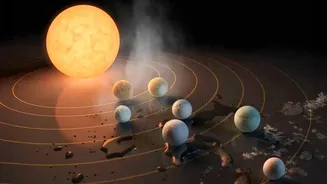
Planets themselves don't emit their own visible light; they mainly reflect it from their star. However, they do absorb energy and radiate it back into space as heat—or infrared radiation. This allows JWST not just to analyse an atmosphere, but also to measure a planet's temperature. By observing this thermal emission, scientists can create 'weather maps' of exoplanets and determine if a rocky planet has an atmosphere at all. This was demonstrated when Webb measured the temperature of the rocky TRAPPIST-1 planets, determining that the innermost one likely has no significant atmosphere. This ability to measure heat is vital for assessing the habitability of worlds in the cooler, temperate zones around their stars where liquid water could exist.