

A Universe of Overwhelming Data
Space exploration has a big data problem. Telescopes like the James Webb Space Telescope (JWST) and observatories on the ground generate staggering quantities of information every single day. NASA’s archives already hold over 100 petabytes of data, with
projections expected to triple by 2030. For perspective, one petabyte is equivalent to about 500 billion pages of standard printed text. This cosmic deluge contains clues about everything from the birth of galaxies to planets orbiting distant stars, but the sheer volume makes finding those needles in the haystack an overwhelming task for human researchers. Analyzing the data from a single powerful telescope could take scientists years, creating a critical bottleneck in the pace of discovery.
NASA’s New AI Co-Pilots
To tackle this challenge, NASA is turning to artificial intelligence. The agency is developing and deploying sophisticated AI systems designed not to replace scientists, but to augment their abilities. A key part of this strategy involves creating “foundation models”—large, flexible AI trained on immense datasets that can be adapted for a wide range of scientific tasks. In July 2026, NASA announced its formal participation in the Genesis Mission, a national initiative to leverage AI for accelerating scientific breakthroughs by applying machine learning across 150 petabytes of agency data. This effort aims to reduce analysis timelines from years to days, freeing up scientists to focus on interpretation and asking bigger questions.
Finding Planets and Filtering Noise
The impact is already being felt in fields like the search for exoplanets. AI algorithms like ExoMiner and RAVEN are poring over data from NASA's TESS and Kepler missions, which look for the tiny dips in starlight caused by a passing planet. These AI tools are exceptionally good at distinguishing a genuine planetary signal from false positives like instrument noise or binary stars. In some cases, AI has confirmed hundreds of new exoplanets, including rare worlds missed by previous human-led analyses. Another practical application is cleaning up images from the JWST. AI models like Morpheus can automatically identify and remove the streaks left by cosmic rays hitting the telescope's sensors, a tedious task that previously consumed valuable research time.
Smarter Spacecraft and Autonomous Exploration
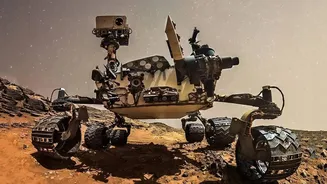
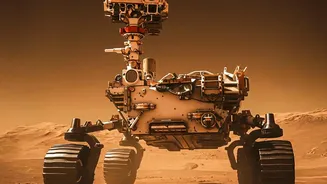
Beyond data analysis, AI is also making spacecraft themselves more intelligent. On Mars, the Perseverance rover uses AI to navigate autonomously, with about 88% of its driving decisions made by its onboard computer analyzing the terrain ahead. This allows the rover to cover ground and explore areas that would be too risky or slow with constant human intervention. Looking forward, NASA is developing next-generation, radiation-hardened computer chips specifically for AI. These processors will enable spacecraft on deep-space missions to make real-time decisions, manage their own health, and even prioritize which scientific data is most important to send back, all without waiting for commands from Earth.
A New Era of Discovery
This integration of AI marks a fundamental shift in the scientific method. It's not just about speed; it's about uncovering patterns that human brains might never spot. By connecting datasets from different missions and fields of study, AI can reveal unexpected correlations and point scientists toward entirely new lines of inquiry. For example, AI analysis of early JWST data revealed the presence of complex disk galaxies far earlier in the universe's history than theories had predicted. These AI systems are becoming indispensable partners in discovery, helping to build a more complete picture of the cosmos by processing information at a scale that was once unimaginable.