



The Standard Story of Cosmic Growth
For a long time, the prevailing theory of how the universe built itself has been the Lambda-CDM model. Think of it as a slow-and-steady cosmic construction project. The idea is that after the Big Bang, tiny fluctuations in density began to pull matter
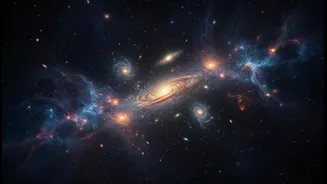
together through gravity. Small clumps of gas and dark matter formed first, gradually merging over billions of years to create larger and larger structures. This hierarchical process meant that the first galaxies should have been small, messy, and structurally simple. The grand, well-ordered spiral and elliptical galaxies we see in our cosmic neighbourhood today, like our own Milky Way, are supposed to be the result of a very long, very slow evolutionary process.
A Glimpse of the Impossible
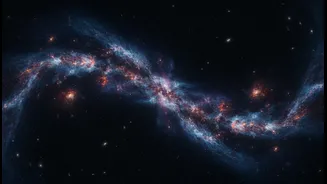
Enter the James Webb Space Telescope (JWST). With its unparalleled infrared vision, it can peer back to the cosmic dawn, a period just a few hundred million years after the Big Bang. And what it's finding is shaking the foundations of cosmology. Astronomers are spotting galaxies from this epoch that are shockingly massive and mature. Objects like JADES-GS-z14-0, spotted less than 300 million years after the Big Bang, are far brighter and more chemically complex than expected. It’s not just one or two oddities; JWST is finding that luminous, large galaxies are far more common in the early universe than any of our models predicted. It’s like looking at a photograph of a two-year-old child who already looks and acts like a teenager.
Too Big, Too Fast, Too Soon
The problem is a matter of time and resources. According to the Lambda-CDM model, there simply shouldn't have been enough time or enough available matter for galaxies to grow so large so quickly. Some of these ancient galaxies appear to contain hundreds of billions of stars, putting them on par with the modern Milky Way. To achieve that, they would have had to form stars at a ferocious rate, hundreds of times faster than our galaxy does today. Furthermore, some of these early systems are already showing complex structures, like rotating nuclear disks, that were thought to have formed much later in cosmic history. This suggests the universe was in a huge hurry to grow up, far faster than our theories allowed.
What Does This Mean for Cosmology?
These discoveries don't necessarily break the Big Bang theory itself, but they do force a major revision of what happened next. The problem lies more in the astrophysics of galaxy formation than in the overarching cosmological model. Scientists are now scrambling to figure out what could have accelerated everything. Was star formation simply much more efficient in the dense, pristine gas of the early universe? Did early, powerful galactic winds from starbursts and mergers play a larger, more dramatic role in shaping galaxies than we thought? Some theories propose that the seeds of these massive galaxies might have been primordial black holes, which would have provided a massive gravitational head start. Other researchers are even questioning our fundamental understanding of dark matter and gravity itself to explain the discrepancies.
The Next Chapter in Cosmic History
This isn't a crisis for science, but rather a thrilling new chapter. Each new image from JWST provides another piece of the puzzle. Researchers are now focused on getting more detailed data, using spectroscopy to confirm the distances and chemical compositions of these surprising ancient galaxies. They need to determine if their brightness comes from an incredible number of stars or from supermassive black holes feasting at their centres, which is another tantalising possibility. These findings are pushing theorists to update their computer simulations to match the reality JWST is observing. The standard model of cosmology, which has been incredibly successful for decades, isn't being thrown out, but it is undergoing its most significant stress test yet.