
A Glimpse into Distant Worlds
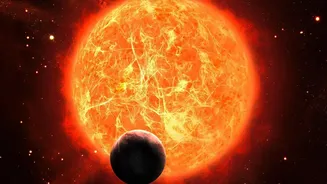
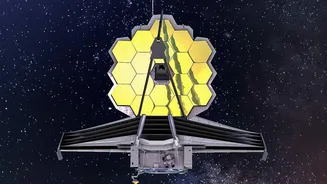
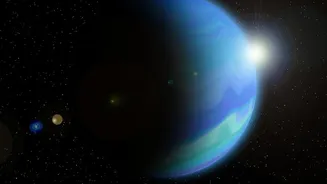
The James Webb Space Telescope has been making headlines since it began operations, but few discoveries carry as much weight as finding water. Recently, scientists have confirmed the presence of water vapor across a variety of exoplanets, which are planets that
orbit stars other than our sun. One notable discovery was made in the planet-forming disk of a young star named PDS 70, located 370 light-years away. Webb’s instruments detected water vapor in the inner region of this disk, precisely where rocky, Earth-like planets are thought to assemble. This is the first time water has been spotted so close to a star in a system already known to be forming planets, suggesting that future worlds born there could have access to water from their very inception.
How Webb 'Sees' Water Across Light-Years
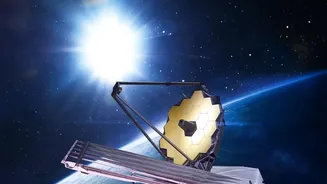
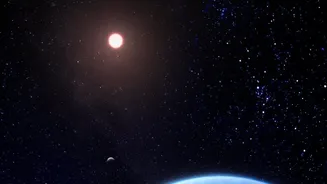
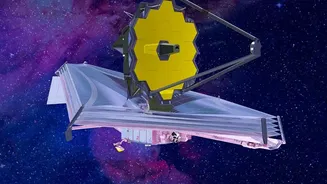
Detecting a single molecule across such vast cosmic distances is a monumental technological feat. The JWST doesn't take a direct picture of rain or oceans. Instead, it uses a technique called transit spectroscopy. As an exoplanet passes in front of its host star from our perspective, a tiny fraction of the starlight filters through the planet's atmosphere. The powerful infrared sensors aboard Webb, like the Mid-Infrared Instrument (MIRI), act like a prism, splitting this light into a spectrum of colours. Different molecules in the atmosphere absorb specific wavelengths of light, leaving behind a unique chemical 'fingerprint'. Water vapor has a distinct and recognizable signature in this spectrum, which Webb's sensitive instruments can isolate and confirm, even from trillions of kilometres away.
The Significance of Water
On Earth, water is the fundamental ingredient for life as we know it. Finding it elsewhere in the galaxy, therefore, is a top priority for astrobiologists. While detecting water vapor is not proof of life, it is a critical piece of the puzzle. It confirms that one of the most essential prerequisites for life can exist in other planetary systems. Discoveries like the one at PDS 70 are particularly exciting because they probe how planets get their water in the first place. Scientists have long debated whether Earth’s water was delivered by comets and asteroids long after its formation, or if it was incorporated directly from the protoplanetary disk. Webb's findings suggest that planets can indeed form with a built-in water supply.
Not All Water Worlds are Habitable
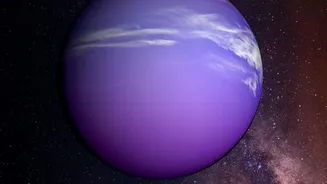
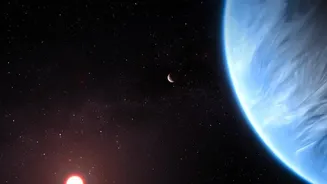
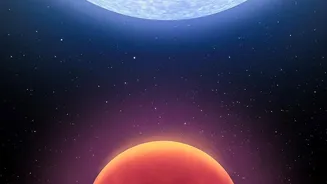
It is crucial to manage expectations. Many of the exoplanets where Webb has found water are far from Earth-like. For instance, WASP-96 b is a hot gas giant with temperatures soaring to around 1,000 degrees Fahrenheit, making it completely inhospitable. Another 'steam world', GJ 9827 d, has an atmosphere composed almost entirely of hot water vapor. These worlds are fascinating for understanding planetary diversity, but they aren't candidates for life. However, Webb has also examined planets like K2-18 b, a potential 'Hycean' world that could have a water ocean beneath its hydrogen-rich atmosphere and orbits within its star's habitable zone. These are the types of targets that will receive intense focus in the coming years.
What Comes Next in the Search
Each detection of water vapor marks a giant leap forward in our ability to characterize alien atmospheres. The data gathered by JWST is helping scientists refine their models of planet formation and evolution. For lead researchers like Giulia Perotti of the Max Planck Institute for Astronomy, Webb has opened a door that was previously locked, allowing measurements that were impossible before. The next steps involve using Webb to search for a full suite of biosignatures—gases like methane, oxygen, and carbon dioxide—in the atmospheres of rocky planets within the habitable zones of their stars. While the journey to find life beyond Earth is long, the detection of water vapor confirms we are finally on the right path, with the right tools for the job.