


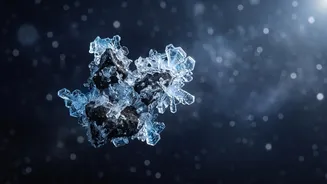
The Solar System's Deep Freeze
Beyond the orbit of Neptune lies a vast, doughnut-shaped ring of icy bodies known as the Kuiper Belt. Think of it as a cosmic deep freeze, holding remnants from the formation of our solar system some 4.6 billion years ago. This region is populated by
millions of frozen objects, from small chunks of ice and rock to dwarf planets like Pluto. Because this region is so distant and cold, scientists believe these objects are among the most pristine and unchanged materials available for study, offering a direct window into the solar system's earliest days. However, sending missions to retrieve samples from the Kuiper Belt is incredibly difficult and expensive, so researchers often have to get creative to study its composition.
Cosmic Dust Delivered to Earth
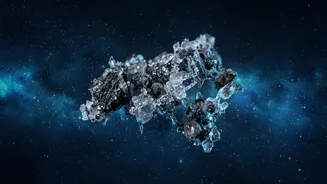
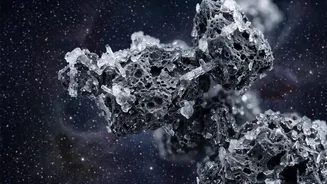
Instead of going all the way to the Kuiper Belt, scientists sometimes wait for the Kuiper Belt to come to them. Tiny dust particles from this distant region are constantly travelling through the solar system, and some eventually fall into Earth's atmosphere. A NASA-led team recently analysed twelve of these microscopic interplanetary dust particles collected high in the stratosphere by research aircraft. By examining the particles, scientists could confirm their origin. They found that the grains were covered in a high density of scars from solar energetic particles, proving they had spent a vast amount of time travelling from the far reaches of the solar system, well beyond Neptune.
Finding the Ghost of Water
The most significant discovery came from what the dust was made of. Researchers found that the particles were rich in clay-like minerals such as saponite. These types of minerals only form when rock comes into contact with liquid water. This indicates that the parent bodies these dust grains broke off from must have once contained liquid water in their interiors, likely melted by heat from radioactive elements in their early history. While that water is long gone, its chemical fingerprint was preserved in the minerals it helped create. It’s like finding a fossil that doesn't just tell you about an ancient creature, but also about the water it drank.
A Reservoir of 'Heavy' Water
This wasn't just any water. By analysing the oxygen locked within the clay minerals, scientists found a unique chemical signature. The water that formed these minerals was highly enriched in 'heavy' isotopes of oxygen, specifically oxygen-17 and oxygen-18. An isotope is a version of an element with a different number of neutrons. The composition of this water was distinctly different from that found on Earth or in most meteorites that originate from closer to the Sun. This finding provides what scientists call 'compelling evidence' for the existence of a massive, primordial water reservoir in the outer solar system. This reservoir appears to have been largely isolated, meaning its contents didn't mix much with materials from the inner solar system.
Why This Discovery Matters
This discovery helps confirm a long-standing theory that the water ice at the solar system's edge has a different chemical makeup, likely due to processes that occurred as the Sun and planets were first forming. The fact that this 'heavy' water reservoir was isolated suggests that the giant planets, like Jupiter and Saturn, may have acted as a gravitational barrier, preventing material from the outer and inner solar system from mixing thoroughly. Understanding this separation helps scientists refine their models of how our solar system evolved and how materials like water were distributed. It's a crucial piece of the puzzle in understanding not only how our own world came to be, but also what to look for in distant planetary systems.