







The Golden Rule: Power Banks Belong in the Cabin
The most critical rule for a smooth security check is this: all power banks and spare lithium-ion batteries must be in your hand luggage. They are strictly forbidden in checked-in baggage that goes into the aircraft's cargo hold. This is a non-negotiable
safety regulation enforced by India's Directorate General of Civil Aviation (DGCA) and global bodies like the International Civil Aviation Organization (ICAO). If a power bank is detected in your checked bag during screening, you will be called to open your luggage, remove the item, and likely have it confiscated, causing significant delays. Packing it in your carry-on from the start avoids this hassle entirely.
The Science of Safety: Mitigating Fire Risk
The reason for this rule is the inherent fire risk associated with lithium-ion batteries, the technology that powers your portable chargers. These batteries can experience a dangerous phenomenon called 'thermal runaway,' where they overheat, ignite, and create a self-sustaining fire that is incredibly difficult to extinguish. Such fires produce intense heat and toxic smoke. If this were to happen in the unmanned, inaccessible cargo hold, it could go undetected and have catastrophic consequences. Keeping these devices in the cabin means that if a battery starts to overheat or smoke, it can be detected and dealt with immediately by the cabin crew, ensuring the safety of everyone on board.
Why Laptops and Tablets Must Come Out of the Bag
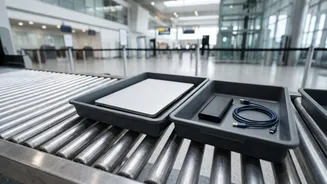
Another common source of delay is the requirement to remove laptops, tablets, and other large electronics from your bag for separate screening. This isn't just a random inconvenience. Airport X-ray machines have limitations when it comes to scanning dense objects. The battery, processor, and other components in a laptop are so tightly packed that they can create a large, opaque area on the scanner's screen. This 'blind spot' could potentially be used to conceal prohibited or dangerous items from view. By placing the laptop in its own tray, security officers can get a clear, unobstructed image of both the device and the contents of your bag, speeding up the process and reducing the need for a manual search.
New In-Flight Restrictions to Know
Reflecting the growing focus on battery safety, rules have also tightened for what you can do in the air. As of early 2026, both global and Indian authorities like the DGCA have banned the use of power banks to charge devices during a flight. This includes a ban on recharging the power bank itself using the aircraft's in-seat USB ports. The rationale is to minimise any activity that could cause a battery to overheat. Furthermore, many airlines and regulators now require that power banks be kept within reach—in a seat pocket or under your seat—rather than in overhead bins, where a fire might be harder to notice quickly.
Pack Smart for a Faster Airport Experience
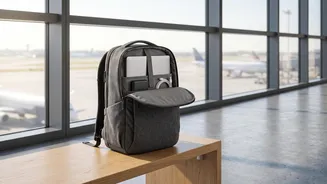
Knowing the rules is half the battle; packing strategically is the other. To fly through security, place all your large electronics and power banks in an easily accessible part of your carry-on bag. This way, you can remove and repack them without rummaging through everything. Ensure your power banks have clear, legible capacity markings (most under 100Wh are fine, but higher capacities may need airline approval). Taping over the connection ports of spare batteries can prevent short circuits. By anticipating the security process and packing accordingly, you not only comply with crucial safety regulations but also make your journey significantly smoother and less stressful.