






1. Cinnamon (Dalchini): The Versatile Embrace
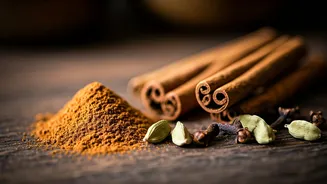
Cinnamon is perhaps the most famous warm spice, beloved for its sweet, woody aroma. The secret to its warmth lies in a compound called cinnamaldehyde, which gives it that characteristic flavour. In India, we are most familiar with the robust, spicy notes
of Cassia cinnamon, a cornerstone of garam masala and countless curries. It brings a savoury depth to meat dishes and biryanis, balancing rich flavours with its subtle heat. But don't limit it to the savoury. A pinch of dalchini powder can elevate your morning chai, transform a simple bowl of oatmeal, or add a complex layer to apple desserts and coffee cakes. For a finer, more delicate flavour, seek out Ceylon cinnamon, which is perfect for desserts where you want the spice to whisper rather than shout.
2. Cloves (Laung): The Pungent Powerhouse
Small but mighty, cloves are the unopened flower buds of a tropical tree, and they pack an intense, pungent punch. Their primary flavour compound, eugenol, is so powerful that it has antiseptic and mild anaesthetic properties—hence its traditional use for toothaches. In the kitchen, a little goes a long way. Stud a few cloves into an onion for a flavourful stock, or drop two or three into your pot of rice to perfume the grains as they cook. They are non-negotiable in rich dishes like mutton rogan josh or festive pulaos. Cloves also have a natural affinity for fruit, especially oranges and apples, and are a key ingredient in mulled beverages and spiced baked goods. Remember to use them sparingly, as their assertive flavour can easily overpower a dish.
3. Cardamom (Elaichi): The Queen of Spices
If there is one spice that captures the fragrance of celebration in India, it is cardamom. Green cardamom (chhoti elaichi) is intensely aromatic, with notes of mint, citrus, and eucalyptus. It's the soul of a good masala chai and the defining flavour of desserts like kheer, gajar ka halwa, and phirni. Crushing the pods just before use releases their essential oils for maximum impact. It also plays a crucial role in savoury dishes, lending its unique fragrance to biryanis and kormas. Its lesser-known cousin, black cardamom (badi elaichi), is larger, with a smoky, earthy flavour profile perfect for robust lentil dishes like dal makhani and hearty meat curries.
4. Nutmeg & Mace (Jaiphal & Javitri): The Sibling Spices
Nutmeg and mace are the ultimate two-for-one spice, as they both come from the same fruit of the Myristica fragrans tree. Nutmeg is the hard inner seed, while mace is the delicate, lace-like covering around it. Nutmeg is warm, sweet, and nutty, perfect for grating fresh over creamy sauces like béchamel, sprinkling on custards, or adding to spinach and cheese dishes. Mace is more delicate and floral, with a hint of pepper. It’s often used in light-coloured dishes where you want the flavour without the dark specks of nutmeg, such as in soups, custards, and some Mughlai preparations. Keeping a whole nutmeg and a small grater on hand is a game-changer; the flavour of freshly grated nutmeg is vastly superior to the pre-ground version.
5. Star Anise (Chakra Phool): The Exotic Beauty
With its beautiful eight-pointed star shape and distinct licorice-like flavour, star anise adds both visual appeal and aromatic complexity. Though central to Chinese five-spice powder and Vietnamese pho, it has firmly found its place in the Indian spice box. It’s a key component in biryani masala and many regional garam masalas, providing a deep, sweet-spicy note that complements the other spices. Use a single star anise in a slow-cooked meat curry or a pot of pulao; its flavour will infuse the entire dish with an exotic fragrance. It pairs beautifully with rich meats like pork and duck, cutting through the fat with its clean, aniseed flavour. Like cloves, it's potent, so one or two stars are usually enough.