


The eventual death of our Sun is a distant but certain fate. For decades, we pictured a relatively orderly end for the outer planets. A new model, however, suggests the process will be far more chaotic, potentially rewriting the solar system's final act.
The Sun's Final Act: The Old Story
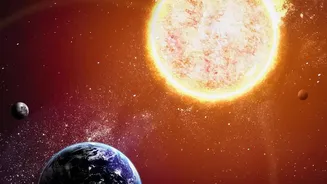
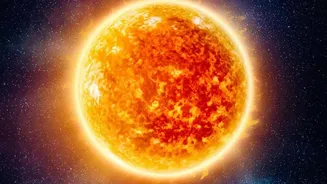
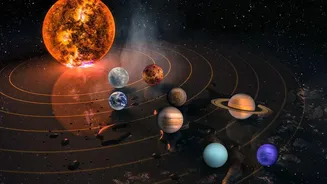
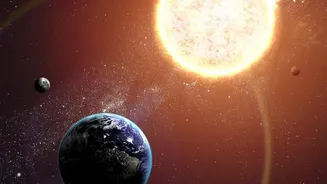
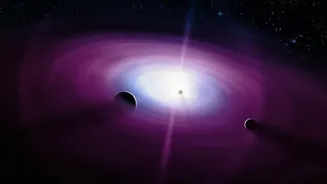
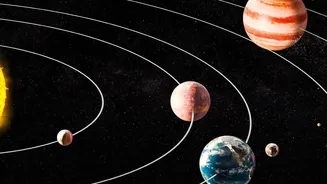
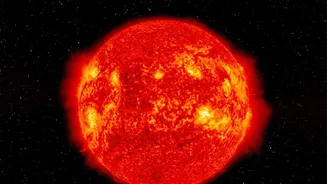
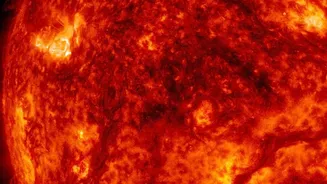
Our Sun, like all stars, has a finite lifespan. In about five billion years, it will exhaust the hydrogen fuel in its core and begin to die. The long-held script for this process is dramatic but predictable. The Sun will swell into a massive red giant, likely engulfing Mercury, Venus, and possibly Earth. After this phase, it will shed about half of its total mass into space and shrink into a dense, Earth-sized remnant called a white dwarf. According to previous models, this mass loss was expected to be a smooth, gradual process. As the Sun's gravitational pull weakens, the surviving outer planets—Jupiter, Saturn, Uranus, and Neptune—would simply drift into wider, but still stable, orbits. It was a picture of a solar system that would become larger and colder, but remain intact for up to 100 billion years or even longer.
A Messier End: The New Theory
Recent research published in The Astrophysical Journal Letters challenges this tidy picture of the end. Instead of a gentle, continuous stream of mass loss, new simulations propose that the Sun will shed its outer layers in thousands of discrete, lopsided bursts. This concept is called asymmetric or stochastic mass loss. The idea is inspired by observations of other white dwarfs, which show evidence of receiving velocity 'kicks' at birth, implying they didn't lose mass evenly in all directions. Each of these uneven ejections would give our Sun a tiny gravitational nudge, a recoil from the escaping material. While a single kick would have little effect, thousands of random pushes over millions of years would accumulate, creating a 'random walk' that perturbs the entire system.
Cosmic Billiards in the Outer Solar System
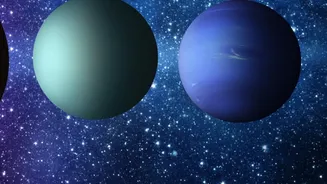
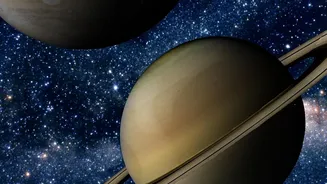
These accumulated kicks from the dying Sun are what introduce chaos. The delicate gravitational balance that has kept the giant planets in their orderly paths for billions of years would be disrupted. The new models show that this instability could begin far sooner than previously imagined, even while the Sun is still in its red giant phase. In hundreds of computer simulations run by researchers, the results were dramatic. In some scenarios, Saturn was ejected entirely from the solar system, becoming a free-floating planet wandering through the galaxy. In others, the orbits of Uranus and Neptune were so disturbed that they swapped places. This orbital chaos drastically shortens the predicted lifespan of our solar system's stable architecture.
A Radically Shorter Timeline
The most striking conclusion of the new model is how much it compresses the timeline for this planetary chaos. Previous estimates suggested the outer solar system could remain stable for 30 to 100 billion years after the Sun becomes a white dwarf. The new research, however, indicates that widespread instability could begin within just one billion years of the Sun's transformation. In about 40% of the simulations, major disruptions began even before the Sun had fully become a white dwarf. In the most extreme scenarios, up to 96% of the simulated systems became unstable within three billion years. This changes the solar system's fate from a near-permanent structure to one that is fragile and highly dependent on the chaotic final moments of its parent star.