



The Challenge of a Static Sky
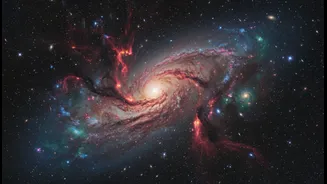
For centuries, astronomy has been the practice of taking pictures. From Galileo’s first sketches to the stunning, deep-field images from the Hubble and James Webb space telescopes, our understanding of the cosmos has been built on these incredibly detailed
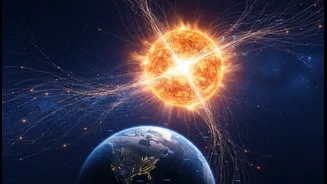
but largely static portraits. While these snapshots are invaluable, they present a fundamental challenge: the universe is constantly in motion. Stars explode, asteroids wander between planets, and distant galaxies shift over cosmic time. When a new object appears or a known one vanishes, it's often difficult to track its origin or destination. Trying to piece together a coherent story from isolated images taken years apart is like trying to understand a movie by looking at a few random frames. Astronomers have been left with a cosmic photo album, when what they really need is a video.
Introducing the Cosmic Movie Camera
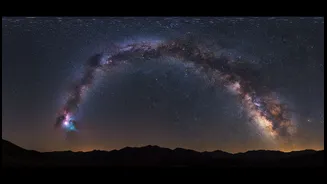
Enter the Vera C. Rubin Observatory. Perched atop a mountain in Chile, this facility recently began a groundbreaking 10-year project called the Legacy Survey of Space and Time (LSST). Its mission is simple in concept but staggering in scale: to create the most comprehensive time-lapse film of the universe ever made. Unlike telescopes designed to stare intently at a single, tiny patch of sky, the Rubin Observatory’s Simonyi Survey Telescope has an enormous field of view. Paired with the world's largest digital camera—a 3,200-megapixel giant—it will photograph the entire southern sky every few nights. This repeated observation is the key. Instead of a single, perfect shot, LSST will capture roughly 800 images of every part of the southern sky over the next decade, stitching them together to reveal a dynamic, evolving cosmos.
Connecting the Dots Across Time
This “wider view” is about more than just capturing pretty pictures; it’s about data and connection. By repeatedly imaging the same areas, LSST allows astronomers to track movement and change with unprecedented accuracy. An asteroid that’s a faint speck in one image can be definitively linked to a faint speck in another image taken a few nights later, allowing for precise orbit calculation. This is crucial for identifying potentially hazardous near-Earth objects far earlier than current methods allow. Similarly, a star that suddenly brightens or disappears isn't just a one-off curiosity. With LSST's data, astronomers can rewind the cosmic tape to see what that star was doing in the weeks and months leading up to the event, providing vital clues about the physics of stellar explosions, or supernovae. The survey will generate around 10 million alerts every single night, flagging changes for scientists to investigate further.
A Deluge of Data
Creating a motion picture of the universe generates an almost unimaginable amount of information. The LSST is expected to produce about 20 terabytes of data every night, culminating in a catalogue of over 500 petabytes. To put that in perspective, a single petabyte is a million gigabytes. Handling this data tsunami is one of the project's greatest challenges and requires a new generation of data-mining techniques, including machine learning and artificial intelligence. Scientists are developing complex algorithms to automatically sift through the data, identify objects, classify them, and flag interesting changes. This approach turns astronomy into a field of data science, where discoveries might be made not by looking through an eyepiece, but by querying a massive, dynamic database of the sky.
Unlocking the Universe's Secrets
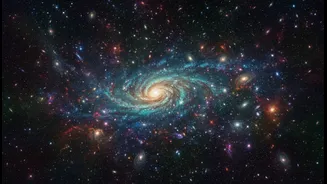
The ultimate goal of connecting these millions of cosmic dots is to answer some of the biggest questions in physics. By meticulously mapping the positions and shapes of billions of galaxies over time, LSST will provide powerful new insights into the mysterious forces of dark energy and dark matter. Dark energy is the force believed to be causing the universe's accelerated expansion, while dark matter is the invisible stuff that provides the gravitational scaffolding for galaxies. LSST's vast dataset will allow scientists to measure the effects of these phenomena with incredible precision. From taking a comprehensive inventory of our own solar system to charting the grand structure of the entire cosmos, this new, wider view is set to revolutionize our place within it.