







The Quest for Water Worlds
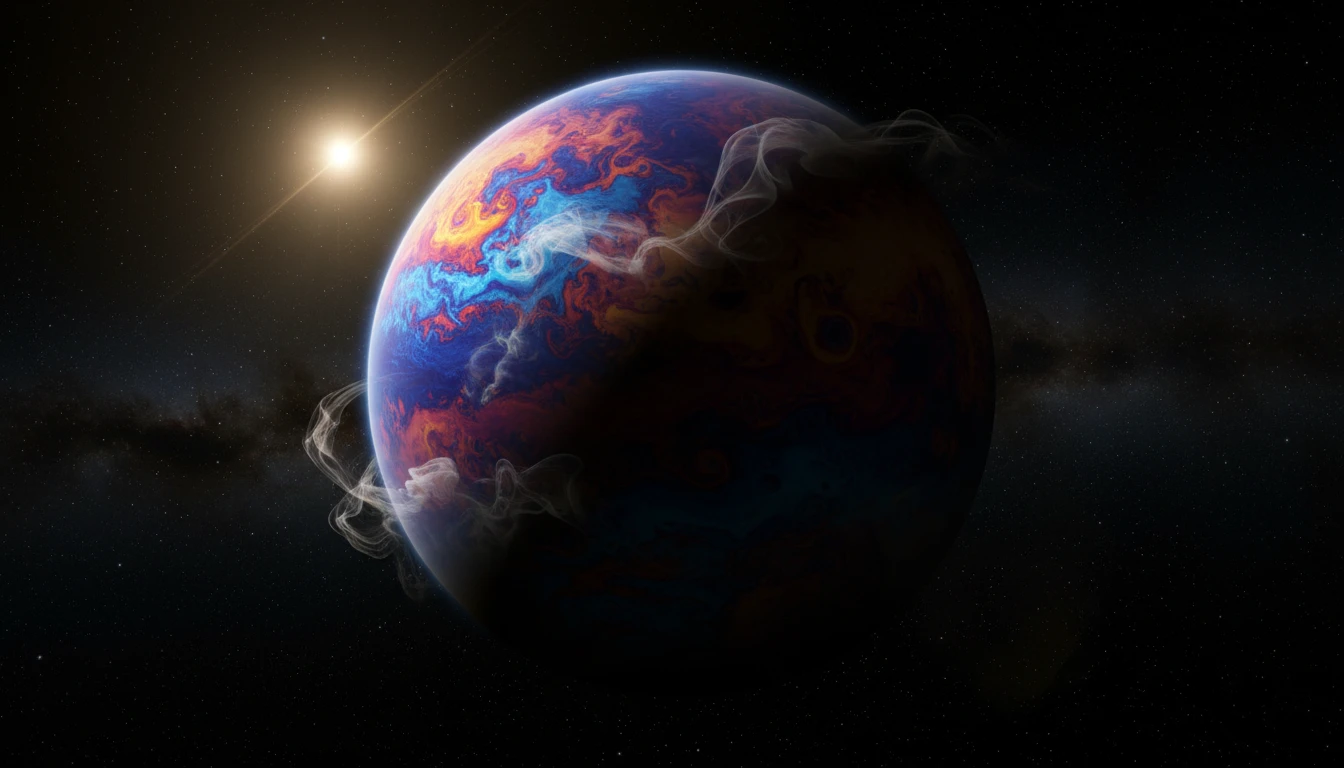
In the vast expanse of the cosmos, the ultimate prize for many astronomers is finding a second Earth—a rocky planet nestled in its star's habitable zone, where conditions are just right for liquid water to exist on its surface. A stable, cycling supply
of liquid water is considered a fundamental prerequisite for life as we know it. This cycle, involving oceans, atmosphere, and precipitation, creates a temperate climate and the chemical environment necessary for life to emerge and thrive. However, directly spotting a small, rocky, water-covered world light-years away is incredibly difficult. Their signals are faint, and their atmospheres are thin, making them a challenge for even our most advanced telescopes.
An Indirect and Clever Clue
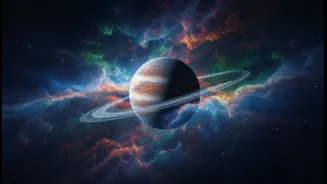
So, how do you find a needle in a cosmic haystack? Scientists have devised a clever workaround. Instead of pointing their telescopes directly at the tiny, hard-to-see rocky planets, they focus on their massive neighbours: the gas giants. These colossal worlds, like Jupiter and Saturn in our own solar system, are much larger and have deep, extensive atmospheres that are easier to analyze. By studying the chemical makeup of these giants, astronomers can gather crucial clues about the entire planetary system, including the potential for water on its smaller, terrestrial worlds.
A Planetary System's Chemical Fingerprint
Planets in a solar system all form from the same initial cloud of gas and dust, known as a protoplanetary disk. This means they are all built from the same primordial soup of elements. The chemical composition of a gas giant, therefore, acts as a historical record of the materials that were available when the system was born. Gas giants, with their immense gravity, hoovered up huge amounts of this original material, effectively preserving a sample of the system's starting ingredients. If the protoplanetary disk was rich in water, the gas giant’s atmosphere will be too.
The Water Vapour Signal
This is where water vapour readings become critical. When powerful observatories like the James Webb Space Telescope (JWST) analyze the light passing through a gas giant's atmosphere, they can detect the spectral signature of water. Finding significant water vapour in a gas giant's atmosphere suggests that water was an abundant ingredient throughout the entire star system during its formation. This dramatically increases the odds that any rocky planets that formed in the same system would have incorporated enough water to eventually form oceans and support a stable water cycle. Essentially, the gas giant acts as a giant, system-wide water meter.
From Giant Planet to Habitable World
The logic follows a clear path: A gas giant with a water-rich atmosphere indicates a water-rich system. A water-rich system makes it far more likely that a rocky planet orbiting in the habitable zone would have captured sufficient water during its formation. This narrows down the search considerably. Rather than painstakingly trying to analyze the whisper-thin atmospheres of countless rocky candidates, astronomers can prioritize targets in systems where the gas giants have already confirmed a water-friendly environment. Recent discoveries have already put this theory into practice, with the JWST detecting water vapour in planet-forming disks that also host giant planets, providing a direct link between the two.